


 Listen to the podcast on Inkandescent Radio
June 2025: Ep2 Tim’s Travails — “The Importance of Embracing Change” is our topic today with attorney Stacey Kalamaras, founding partner of Kalamaras Law Office LLC, an intellectual property boutique in Chicago
June 2025 — Having started her career in Washington, DC, close to the United States Patent and Trademark Office, and more recently here in Chicago, Stacey worked for one of the world’s largest law firms, managing global trademark portfolios. But her journey wasn't in a straight line. find out how she learned to pivot, and is the better for it.
Read
Listen to the podcast on Inkandescent Radio
June 2025: Ep2 Tim’s Travails — “The Importance of Embracing Change” is our topic today with attorney Stacey Kalamaras, founding partner of Kalamaras Law Office LLC, an intellectual property boutique in Chicago
June 2025 — Having started her career in Washington, DC, close to the United States Patent and Trademark Office, and more recently here in Chicago, Stacey worked for one of the world’s largest law firms, managing global trademark portfolios. But her journey wasn't in a straight line. find out how she learned to pivot, and is the better for it.
Read
June 2025: Ep2 Tim’s Travails — “The Importance of Embracing Change” is our topic today with attorney Stacey Kalamaras, founding partner of Kalamaras Law Office LLC, an intellectual property boutique in Chicago

June 2025 — This month on IP attorney and author Timothy Trainer’s podcast/video show we meet Stacey Kalamaras, the founding partner of Kalamaras Law Office LLC, an intellectual property boutique in Chicago, IL.
Today’s Topic: The Importance of Embracing Change
On today’s episode, Tim asks Stacey:
- Tell us about the importance of ensuring small businesses protect their brand/logo/trademarks.
- Why is it so essential, and should this practice be part of a small business strategy?
- What is your opinion of what’s going on today with global trade and tariffs? How will it impact small businesses?
- What is your forecast for the future of small businesses and protections?
About Stacey: Having started her career in Washington, DC, close to the United States Patent and Trademark Office, and more recently here in Chicago, Stacey worked for one of the world’s largest law firms, managing global trademark portfolios. She has spent over 30 years working for some of the world’s most beloved brands in more than 150 countries and for clients in diverse industries. In January 2018, with the founding of her eponymous firm, she now assists small and medium-sized businesses identify, register, protect and commercialize their brands both in the U.S. and abroad. Before going to law school, she was a brand manager and advertising director in the consumer-packaged goods industry, which gives her valuable insight into her clients’ businesses on a practical level.
Awards and Peer Recognition: Stacey has been recognized by her peers as a Super Lawyer® for the past six years for her outstanding knowledge and service in intellectual property law, a recognition and honor given to just 5% of the lawyers in Illinois. The firm was recently recognized by CorporateLiveWire as Trademark Law Firm of the Year for Illinois for 2024/25. Stacey was ranked among World IP Forum’s 2021 list of 250 Powerful Women in IP and was profiled by The Top 100 Magazine as a top lawyer for 2020. Learn more at klolegal.com.

About Tim’s Travails: In this podcast/video sereis, IP attorney and author Tim Trainer introduce us to experts around the country who have insight into the law, international trade, and more, to help us better understand our world in 2025 and beyond.
Tim himself fits the bill. He worked for three decades for the US government and private law firms focusing on international trade and has developed a deep understanding of global economics and politics.
Writing books is his passion. The author of seven books as of 2025, he has penned several non-fiction tomes, including his first book, Customs Enforcement of Intellectual Property Rights; the 15th edition was published in 2020. Thomson Reuters’ Aspatore Books published Tim’s next title in 2015, Potato Chips to Computer Chips: The War on Fake Stuff. Fiction was a genre he always wanted to try. In 2017, Pendulum Over the Pacific was released by Joshua Tree Publishing. “This political intrigue story is set in Tokyo and Washington, D.C., and centers on trade tensions between the U.S. and Japan in the late 1980s,” Tim explains. In 2023, his first series hit bookstores: The China Connection. In December 2024, he followed it with The China Factor.
Stay tuned for more episodes on InkandescentRadio.com and Inkandescent.tv, and of course, log in regularly for new blog entries and other information on Tim’s website, www.TimothyTrainer.com.
Read“Memorial Day: Thoughts of the Past and Present,” by IP attorney and author Timothy Trainer

Was it late 1966 or 1967? I don’t remember the precise year or month. I had just entered my teens. What I do remember is opening a letter from my father. It was during the first of his two combat tours in Vietnam. To this day I remember reading that Sgt. Parker had been killed. Sgt. Parker and my father had been posted to Ft. Knox prior to their respective orders informing them that they were heading to Southeast Asia.
The letter was about the death of a career soldier. It left me thinking about one of Sgt. Parker’s sons, my age. I knew Sgt. Parker’s son from playing pickup baseball games in our Ft. Knox dependent housing neighborhood. I knew that Sgt. Parker had a handful of young kids and after reading that letter all I could think about was what would happen to them now that their father had been killed. It’s something I will never know, but it’s still something that comes to mind occasionally or, perhaps, more often than I care to admit.
 As I can still recall reading about Sgt. Parker’s death and my thoughts turning to his kids, there was another reason for that bit of information. It didn’t register right away. I don’t know when it dawned on me that the letter about the death of Sgt. Parker was my father’s way of preparing me in case it happened to him. Thankfully, we never had to endure that kind of loss and feel the pain that comes with such a loss.
While Memorial Day wasn’t declared a national holiday until 1971, its origins date back to the Civil War: www.va.gov. It was originally referred to as Decoration Day because it was the day to decorate the graves of those who died in the Civil War. After World War I, the observance was expanded to remember those who died in all of our wars.
This coming weekend’s holiday is intended for us to take the time to remember those who gave their lives in our wars. While many will simply see this as a three-day weekend marking the beginning of summer, we should also remember the families left to grieve. There are spouses, children, parents, siblings and other family members who feel the pain of those lost in our wars. Along with the moment of remembrance spent to honor those lost, it is also important to remember those living with those losses.
We should also remember that there is that family of brothers and sisters in arms who also feel the loss. This is the other family that is often overlooked. Far too often, they were unable to take the time to grieve the loss when it occurred. The men and women who survived the firefight, the battle, the war in which one of their own is lost are members of a different kind of family. For those who lived and witnessed that last breath, that last moment of life, the toll on them is no less and possibly more than the toll on traditional family members. For many, those images of those moments of loss will never leave them.
Memorial Day is dedicated to remembering those who died fighting in our wars. Hopefully, most will take a moment to remember that during the long weekend. It is also important to remember that we owe much to those who are still living and who have served and suffered the physical and mental scars of serving in harm’s way. We reserve a day to remember those we’ve lost. We should make sure that every day we remember to support and provide what is needed for those who survived.
 About The Fortunate Son, by Timothy Trainer
In this book, Tim recounts the parallel lives of an army brat and a group of Vietnam veterans who intersect decades after the war. “The veterans open up to me, the army brat, perhaps in a way they never have with their own families,” explains author Timothy Trainer. “Through my father, Top, their First Sergeant, we have a common link. Over the years, we’ve gotten to know each other. They begin to understand the sacrifices of an army family. But, more importantly, they want me to understand how our family’s sacrifice and my father’s tour of duty in Vietnam with them, in the jungles, gave them confidence to believe they would make it home alive.”
The Fortunate Son is not about a single battle or a single soldier’s tour of duty. You will meet us, learn something about us, and get a glimpse of our lives during the war years. You’ll find out why half a century after that tour of duty ended, we remain bound together. If you’ve ever been in the military or part of a military family, you’ll know that we all are bound together. For those who find the military to be foreign and unknown, our story may help you to understand why it binds so many together.
Fourteen of these soldiers have shared their stories. Their stories describe two life transitions—first from civilian teenagers or young men to combat grunts trying to stay alive in the jungle—and then back to stateside life. What happens between these transitions, as they slog through the jungle day by day paints their portrait of Top, my father. Now, I appreciate why they remain bound together half a century after their tour ended. Their stories are an unexpected gift that bestows new insight to me on my father. So, as you read and “listen” to these soldiers’ stories, both what they say and how they describe Top, you understand why I’ve learned that I am The Fortunate Son.
Click here to watch more videos from The Fortunate Son on TimothyTrainerTV.
 About the Author: Tim Trainer is an army brat. He was born into the Army in Japan and was a high school junior when his father retired from the Army. Typical of Army or military brats of the times, he had attended 10 schools by the time of his high school graduation. He did not arrive in the United States until he was past his fifth birthday. After arriving in the United States, the Army life meant living in various parts of the United States, on and off post, depending upon his father’s duty station.
He had three “tours of duty” at Ft. Knox, KY, (some elementary school, some high school, and basic training). Upon his discharge from the Army in July 1975, he left the Army behind permanently. At the time of his discharge, he was twenty-one and half years old but had spent twenty years as either an army brat or on active duty.
After the Army years, he eventually earned a law degree and moved to the Washington, D.C., area in 1987. Since moving to the Washington, D.C., area, he has worked as an attorney in federal government agencies and in the private sector. He has traveled extensively around the world, including several trips to Vietnam.
This work is evidence that his break from the Army was not “permanent.” In the late 1990s, his father, who was reuniting regularly with men he had served with in B2-7, invited him to meet the guys when they met in Washington, D.C. This led to his father’s invitation to attend a summer reunion in 2003. Since 2003, Mr. Trainer has been a regular attendee of the B2-7 reunions in Washington, D.C., and at the summer gatherings at what he calls “Camp Gast.”
Learn more about Tim and his books: TimothyTrainer.com
Read“The Big Sigh as US-China Engage,” by author and IP attorney Timothy Trainer

May 13, 2025: The “deal” that isn’t really a deal. This amounts to buying time to allow both sides to sit down and talk about the possibility of some type of economic agreement. Simply talking caused U.S. markets to fly high on May 12: Wall Street equity indexes close higher after US-China tariff truce | Reuters. It’s worth noting, too, that Reuters refers to what happened as a truce, not a deal.
Though the two governments announced this tariff truce and lowered tariff rates, a few trade issues seemed to evade clear answers. Will China ease restrictions on exports of rare earth minerals that U.S. companies and the defense industry rely upon? There seems to be some opinions that China is likely to continue using rare earth minerals as a lever in its negotiations with the U.S.: After U.S. and China pause tariffs, rare mineral exports now in the spotlight of future trade deals | Fortune.
Any U.S.-China bilateral engagement is wrought with significant challenges. These challenges are because the trade value between the two biggest economies was approximately $583 billion in 2024. https://www.census.gov/foreign-trade/balance/c5700.html. Given the volume and value of trade between the two countries, the negotiations will require a lot of hard work and a commitment from both sides to fulfill the obligations an agreement when one is reached.
 It is worth noting that the U.S. and China have engaged in years of discussions related to bilateral economic and commercial activities. The relationship has had its turbulent periods. Before China entered the World Trade Organization, the U.S.’s allegations of China’s massive exports of substandard, counterfeit goods to our market triggered legally required consultations in the late 1990s. That period also included U.S. threats to impose trade sanctions. The sanctions were avoided when China committed to undertake steps to address the problem. Unfortunately, years after these commitments, China has remained the main source of counterfeit goods seized by U.S. authorities at the border.
The U.S. and China have also created other mechanisms for bilateral talks aimed at addressing economic and commercial issues. As far back as 1983, the U.S. and China established the Joint Commission on Commerce and Trade for the purpose of “addressing bilateral trade matters and promoting commercial opportunities between the United States and China.” geneva.usmission.gov. From 2006 to 2017, the U.S. and China also engaged in another bilateral discussion framework that began as the Strategic Economic Dialogue then renamed the Comprehensive Economic Dialogue.
Basically, the two governments have been in constant dialogue on economic and commercial issues for decades. Anyone can argue the efficacy of all these meetings regardless of the framework constructed for holding bilateral talks. Each side has known what the other is unhappy about throughout the decades as they’ve been discussed for many years.
As the two governments have called a truce while they discuss how to move forward, a sigh of relief could be heard around the world on May 12. We will now await what happens during the discussions that will be held over the coming weeks.
What are the two heads of government doing? While the U.S. tends to claim some victory, China’s Xi was meeting with Brazil’s president as those two countries work to hammer out agreements on future projects and cement a stronger economic bond. Brazil seeks China trade boost amid Trump tariff chaos as Lula meets Xi. In addition, China’s Xi will be speaking at a forum this week in Shanghai where Caribbean and Latin American government heads of state will be in attendance. China’s President Xi Jinping to speak at opening of China-CELAC Forum on Tuesday | Reuters.
Americans shouldn’t be fooled into thinking that all is well because of the current U.S.-China truce in the tariff war. The geo-economic strategies of all our trading partners need to be studied as our future economic health depends upon what others do. In particular, it is critical to our economic future that we watch and analyze how China is working to create economic relationships to protect itself from U.S. decisions that might have negative effects on its economy. The question is whether the team the U.S. has assembled is up to the task of what’s needed for the U.S. economy to thrive in a global environment.
ReadCongratulations to Timothy Trainer’s “The China Factor” now #63 on Amazon’s Asian Literature list

May 2025: Timothy Trainer’s 2024 book, “The China Factor,” popped into the Top 100 in Asian Literature for Amazon Kindle books — moving from number 450 to 63. Click here to get your copy!
About The China Factor
In the spring of 2005, the FBI foils a government employee’s attempt to provide confidential information to the Chinese. As the FBI struggles to understand why the information is valuable, its investigation entangles Capitol Hill staffer Kellie Liang and jeopardizes her nomination to a State Department position. Under scrutiny, Kellie thrusts herself into the FBI investigation. Seeking a voice of reason, Kellie reaches out to Aaron Foster only to learn that he is vacationing in Vietnam with his uncle, a war veteran. Surprisingly, Aaron believes he has found a Chinese corporate connection to the information theft, and from two sides of the world, Kellie and Aaron work to thwart China’s efforts and save Kellie’s nomination.
Timothy Trainer, an attorney, worked in multiple federal government agencies and in the private sector. His non-traditional legal career included a significant focus on international trade issues. His work required extensive travel around the world, including dozens of trips to the Asia-Pacific region. His experiences led him to co-author a legal treatise for fifteen years, penning the novels, The China Connection and Pendulum Over the Pacific, and authoring a non-fiction book, The Fortunate Son: Top, Through the Eyes of Others, about men who served in Vietnam with his father.
ReadKent State: 55 Years (War, Protests and Lessons), by Timothy Trainer

We often commemorate events in ten-year intervals or at the quarter century, half-century or century mark. This year, however, it seems appropriate to remind ourselves of a day 55 years ago on May 4, 1970. In view of the onslaught of federal government cuts to university research funding, threats to foreign students, and the White House’s threats aimed at universities that fail to bend to the President’s will and way of thinking, we should remind ourselves that those who are in positions of power can press the panic button that leads to the most extreme government actions.
The tragic shooting and killing of students on May 4, 1970, followed years of nationwide campus unrest and protests regarding U.S. involvement in Vietnam. It’s worth noting that during the first several months of 1970, April proved to be the deadliest with 730 U.S. troops killed during that month, including 70 killed on the first day of April. Firebase Illingworth Illuminated in a Titanic Horror – VFW (additional statistics available: amerianwarlibrary.com/vietnam/vwc24.htm).
Between 1964 and the end of 1969, the military draft had resulted in the induction of over 1.5 million young American men. https://www.sss.gov/history-and-records/induction-statistics/. During that same period, over 48,500 Americans had died in Vietnam. https://www.archives.gov/research/military/vietnam-war/casualty-statistics. Tens of thousands of others serving in Vietnam were wounded. On April 29, 1970, President Nixon ordered the military incursion into Cambodia and informed the country of this development the next day. The expansion of the war into Cambodia was met with protest around the country. https://www.archives.gov/exhibits/remembering-vietnam-online-exhibit-episodes-9-12.
 Whether young adult males were in college or not, they were needed to serve and fight in Vietnam and Nixon’s speech was seen as expanding the war not an attempt to bring the war to an end. Nixon’s announcement resulted in college student reactions around the country: historicexhibits.lib.iastate. At the time, the reaction in Ohio was similar to those on other campuses and college towns around the country.
The reason the Kent State shooting becomes even more important today is because of the way the federal government and Trump are targeting universities and students. Just as political leaders ignored their young constituents more than half a century ago, those in political leadership in the nation’s capital today seem intent on ignoring or, worse, punishing those whose opinions are not in line with what the White House wants to hear.
The U.S. Government should not force a way of thinking, requiring institutions of higher education to bend to one man’s set of facts and opinions. If these places are intended to be centers for learning, part of that mission is to be a place of diverse opinions, diverse peoples and the willingness to debate issues from all sides.
University and college campuses are places where young minds should be exposed to new thinking, different thinking and where we challenge what has been learned and observed. The point of education is to broaden us as individuals; it is not for us to surrender to someone else’s ego-driven desires.
History should teach us, inform us of something. Fifty-five years ago, the war, the political conduct of the war and the tensions between opposing views of what should be done resulted in the government’s use of deadly force.
There are many lessons arising from that day and each person will take from that event what they wish. One thing is certain, some in the ruling-political class of that time didn’t want to accept the views or opinions of those opposing the war. Ultimately, armed force, lethal force was unleashed on the Kent State campus.
The government, whether at the federal or state level, has the tools available to call upon those who are armed and in the service of the government and in the name of the citizenry to quell and quash those whose opinions the government doesn’t like or to simply ignore the laws of the land and act beyond the law to intimidate those who speak out against the government.
What was true 55 years ago and remains so today is that whether it is an institution of higher learning or anywhere else, differing opinions exist around a set of established facts. Under our system, the government may set policies and implement them, but the government does not tell us what opinions to hold, how we interpret facts presented and whether we can express those opinions. The lesson is that we cannot allow the government to suppress thought and speech because there are times when the government’s actions demand a response from the people.
Watch
Listen to the podcast on Inkandescent Radio
May 2025: Ep1 Tim’s Travails — Don’t miss this new podcast/video show on InkandescentRadio.com and Inkandescent.tv featuring intellectual property attorney and author Timothy Trainer
May 2025 — Stay up to date with Tim's blog, where he regularly writes about topics that provide a glimpse into how the Trump administration handles international trade. What inspires these posts, and what can readers hope to learn? Listen to our interview here, and read all about it at TimothyTrainer.com.
Read
May 2025: Ep1 Tim’s Travails — Don’t miss this new podcast/video show on InkandescentRadio.com and Inkandescent.tv featuring intellectual property attorney and author Timothy Trainer
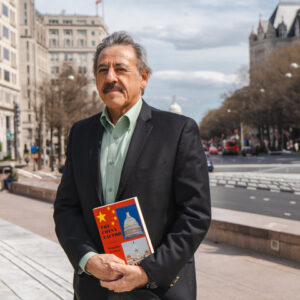
May 2025: Hello friends! I’m Hope Katz Gibbs, founder of Inkandescent, and I’m so happy today to introduce you to our new client and podcaster — IP attorney and author Tim Trainer. We met at Elaine’s Literary Salon just after his 3rd novel, The China Factor, was published this year. In the months since, our Inkandescent team has had the privilege of launching his new website, TimothyTrainer.com and posting entries to his blog that talks from experience about international trade, especially with China, as well as the current state of global economics and politics.
Writing books is his passion. In his downtime, Tim found time to pen a few non-fiction tomes, including his first book, Customs Enforcement of Intellectual Property Rights; the 15th edition was published in 2020. Thomson Reuters’ Aspatore Books published Tim’s next title in 2015, Potato Chips to Computer Chips: The War on Fake Stuff. Fiction was a genre he always wanted to try. In 2017, Pendulum Over the Pacific, was released by Joshua Tree Publishing. “This political intrigue story is set in Tokyo and Washington, D.C., and centers on trade tensions between the U.S. and Japan in the late 1980s,” Tim explains. In 2023, his first series hit bookstores: The China Connection. In December 2024, he followed it with The China Factor.
On this podcast/video show, Tim’s Travails, will be talking about topics and interviewing other experts who will help us better understand our world in 2025.
Today, in Episode 1, we focus on Tim who shares:
- You grew up with a father who had an impressive career in the Army. Tell us about your experience as an “Army brat,” and what led you ultimately to pen, “The Fortunate Son.”
- Tell us about what led you to become an intellectual property attorney and what your 30-year career was like, traveling the world and specializing in international trade.
- In your blog, you write about topics that provide a glimpse into how the Trump administration is handling international trade, especially with China. Headlines include “Hairline Fracture or Clean Break,” in reference to an April 16 article in Raw Story: Trump business allies reeling as they realize ‘he is crazier than they thought’: analysis – Raw Story. In a post called “Shutdown Threats and the Numbers Game,” came just before the government threatened to shut down. Tell us about what inspires your posts, and what you hope readers learn.
- In this podcast/video show, you’ll be tackling other important topics. Who will be some of your guests?
- We’ll also be doing something fun: Having conversations with the characters in your books. I think it’s fascinating to hear from the author about the backstory of their characters and what helped to birth them on the pages of the books. Today, can you pick one character and tell us about him/her?
- What’s next for Tim Trainer? More books?
Stay tuned for more episodes on InkandescentRadio.com and Inkandescent.tv, and of course log in regularly for new blog entries and other information on Tim’s website, www.TimothyTrainer.com.
Read“Vietnam: 50 Years of Transformation,” by Timothy Trainer

April 30, 2025, marks the 50th anniversary of the fall of Saigon in 1975. Saigon, renamed Ho Chi Minh City, fell to North Vietnamese troops on this date. Twenty-nine years earlier, in a January 18, 1946 letter, Ho Chi Minh wrote to President Truman that stated, in part, “[t]he French have tremendously increased their fighting forces. Millions of people will suffer, thousands will be killed and invaluable properties will be destroyed, unless the United States would step out to stop that bloodshed and unlawful aggression. . .. I respectfully request you to interfere for an immediate solution of the Vietnamese issue. The people of Vietnam earnestly hopes that the great American Republic would help us to conquer full independence and support us in our reconstruction work.” historynet.com/ho-chi-minh-truman-letter-vietnam
History informs us that the U.S. did not respond to the letter as Ho Chi Minh had hoped. Instead, the U.S. pursued a course that would take us into Vietnam and engage in a war that is still subject to many debates and controversies.
Much has changed in Vietnam during the intervening half century. An agrarian country has transformed itself into a hub of activity. Today, Vietnam’s energetic population fuels a growing economy. The country attracts foreign investors who see the economic potential of an industrious population. In turn, increased opportunities provide its citizens with opportunities to continue the country’s rapid economic development.
While the country is described as a politically communist country, Vietnam’s commercial activity, both domestic and international, relies on a capitalistic approach. It is more appropriate to consider Vietnam as having a “socialist-oriented market economy.” Is Vietnam still a communist country? – Geographic FAQ Hub: Answers to Your Global Questions. Recalling a 1997 trip to Moscow and Hanoi only weeks apart, the two capitals could not have been more different to this traveler. While Moscow’s store shelves seemed bare, Hanoi’s streets buzzed with commercial activity where people busied themselves in all forms of commercial activity. The streets of Hanoi were alive while those in Moscow were gloomy.
Vietnam is following in the tradition of other Asian countries as it climbs the ladder in economic performance. Depending upon whose data one looks at, Vietnam ranks in the mid-thirties for gross domestic product in the world. GDP by Country – Worldometer, Vietnam GDP – Gross Domestic Product 2005 | countryeconomy.com, Vietnam’s Booming Consumer Class – The Globalist.
Having watched a war on the nightly news and endured the daily “what if” during my father’s two combat tours of duty in Vietnam, it is gratifying to see a country we once deemed an enemy grow and develop as Vietnam has. With multiple trips to Vietnam over the past quarter century, the takeaways include observations of enthusiastic students, hard-working people and a country that emits a palpable and infectious level of energy.
Despite the miscalculations and missed opportunities in the past, we should endeavor to grow our relationship with a country that has so much going for it. Hopefully, our current policies will not drive the country away when there is so much to gain.
Read“Sledgehammer or Scalpel?” asks IP attorney and author Timothy Trainer

We love to target the government. Many have the image of lazy, overpaid government employees. What do they do to improve the lives of citizens? What do they do to improve the ability of our businesses to compete in an ever more competitive global business climate? How does the government protect our international interests militarily and otherwise? Well, the questions about what the federal government does for its citizens and the country could go on and on.
Most will likely agree that sledgehammers and scalpels are very different. If the goal is to break up a slab of concrete, it’s probably a lot easier to do that using a sledgehammer, but that same sledgehammer is the wrong tool to use if cutting into a body to get at a joint that needs replaced or to access a body organ. In many ways, the lack of precision in reducing government waste is likely to result in the kind of damage a sledgehammer causes.
It is not difficult to get agreement on the topic that there is waste in government. The federal budget is like many household budgets. For most, there’s always room for cutting expenses. The question is who should do the cutting and how it should be done.
What we’ve witnessed during the past few months is a sledgehammer approach by people who do not understand the role of the federal government, what it does, how it does it and why. Businesspeople and entrepreneurs have an enormous advantage over the government because they concentrate on a return on investment (profits) and oversee an operation that is much more limited and focused than what a government is expected to deliver to its citizens. At this point, the vast array of what the government is expected to deliver for its citizenry and businesses is an endless list. Some are simple things like national security, but even that is not as simple as many might wish to believe.
Today, the concept of national security is much more complex than one might imagine. Simplistically, it might be understood to be those who serve in the armed forces. It’s the “military”, but that fails to capture the concept of national security in all its forms. Does the concept of national security include the research and development of the latest technologically advanced weapons systems? If so, who does all this research, and where? Who manufactures these systems? Should economic issues be considered as part of “national security”? If so, what does that entail? Should the government take on the task of ensuring that U.S. businesses are treated equally under the law in a foreign country as if they were a domestic company? A discussion on national security can quickly expand into areas that many may never have expected.
Given the fact that the federal government is not transparent in the numbers of government employees being fired or taking buyouts, there are no precise numbers. However, the New York Times has attempted to compile statistics that reflect the number of job cuts, buyouts, and expected future reductions to federal agencies. The Times’s effort to compile the numbers reaches an overall federal employee reduction of roughly 270,000. What We Know About the Trump Administration’s Cuts to the Federal Work Force – The New York Times
The challenge for anyone cutting government staff is to understand why a particular office exists, what it does and how many people it might take to fulfill a particular mission. Simply eliminating offices and staff without the appropriate analysis can do more harm to the government’s overall mission.
For all intents and purposes, the gutting and elimination of the U.S. Agency for International Development (USAID) is a great example of doing harm without assessing what it does and how it delivers positive results for the U.S. While the superficial appearance of the activities of USAID may seem wasteful, this should not be the basis for the complete elimination of the agency and its activities.
For example, do we want to encourage a more positive business climate for U.S. businesses in foreign countries so they can operate under fair and equitably applied laws and regulations? If the answer is yes, then USAID activities that addressed commercial law issues in a particular country, working with a foreign government to improve laws and regulations that would attract more U.S. commercial opportunities and improve the ability of U.S. businesses to generate profits, seem to be worthwhile activities. These were activities conducted in numerous countries. Essentially, USAID worked to provide a more welcoming legal landscape for U.S. businesses. These are not activities individual companies undertake.
There is no doubt that some of USAID’s work was duplicated by other government offices. Several government offices and agencies are involved in economic and commercial development programs abroad that work to improve the business climate for U.S. businesses, but the sledgehammer approach fails to appreciate the work, the skill sets, and expertise that are needed to engage various foreign government agencies to make necessary progress.
A more precise management approach to reorganize or consolidate agencies, offices, and staff that are tasked with these projects is more efficient than the wholesale elimination of the agency without consideration of the goodwill these projects generated toward the U.S.
While USAID is only one agency, there are other losses among these personnel cutbacks that are priceless. No price tag can be placed on the loss of institutional knowledge, expertise, and specialized skills of thousands of employees leaving government service. Ultimately, the country will likely pay a high tax price to rebuild what is lost. It’s hard to fix anything if you fail to use the right tools.
Read“Hairline Fracture or Clean Break?” asks IP attorney and author Timothy Trainer

This isn’t about an accident involving the need for medical attention. Nor does this refer to a marriage with problems. Headlines can grab attention when they include words like “crazier than they thought” in reference to businesspeople saying that about the president. Trump business allies reeling as they realize ‘he is crazier than they thought’: analysis – Raw Story (April 16, 2025). Apparently, within the business world, the supposed businessman at the helm seems crazy to some of his fellow executives.
Reading something like this should raise lots of eyebrows. One serious question to ask is whether the greed factor of many executives is so great that they ignored or overlooked so many warning signs pointing to the negative effects on the country and its people. Why are business leaders surprised? Aren’t they old enough to remember Trump’s first term? Didn’t they see how tariffs during that first term fell far short of the stated goals of the businessman in chief?
The reaction of the business world is not limited to U.S. executives. Globally, there is a massive shift that may be underway and unstoppable. The tariff impositions and threats from Washington have had a tidal wave effect. China’s leader is not blind to things happening outside of China, and the United States, as a headline on April 16 read: China Pounces as Trump Turns on Europe. China pounces as Trump turns on Europe. The Telegraph article states that the “trade war has given China the chance to shake off its image as the rogue giant of global trade and investment, and appear as a pillar of stability in contrast to a volatile and unpredictable US.” Unfortunately, it’s hard to argue with this point in view of Trump’s constantly changing position on tariffs.
Every day seems to bring new rounds of chaos as the guessing game continues in April. Given all the announcements this month, referencing a chart like the one provided by NBC News is needed to keep up with these announcements. Trump tariff timeline: How the U.S. turned global trade into an economic battlefield.
- The April 2nd announcement of 10% tariffs for the world was followed by the April 3rd announcement of an additional 25% on auto parts.
- On April 8th, an additional 50% tariff went into effect for Chinese goods, with an additional 21% added the next day, along with an announced 90-day reprieve for the rest of the world regarding the 10% announced on April 2nd.
- On April 11th, tariff exemptions were announced for electronic products, Smartphones and computers are now exempt from Trump’s latest tariffs | CNN Business, though these exemptions might be lifted at an announced time, injecting instability into the news of the electronics goods reprieve.
With China, the European Union, and other governments looking to bolster their trade and economic relationships without the U.S., it should make everyone think about the future economic health and stability in the U.S. Moreover, with China’s announced bans of exports of rare earth minerals along with a government order to stop acquiring Boeing planes, the trade war takes on a new dimension far beyond just tariffs, i.e., prices of goods.
In addition, hints at foreign governments not seeing the U.S. as an economically stable place to invest are likely to result in other types of economic pain in the form of higher interest rates for homes, cars, and other products. What you need to know about the sell-off of ‘safe haven’ US bonds | AP News. Thus, while the U.S. has sought in recent years to have our companies become less reliant on China by moving facilities back to the U.S., the current overall picture of the world is that foreign governments do not see the U.S. as a stable and reliable place to place bets on and continue financing U.S. debt thereby moving away from us. It is unrealistic to believe that the U.S. can maintain the kind of standard of living and comfort we’ve become accustomed to by implementing policies that drive away governments that provide the economic support necessary for the U.S. to thrive.
As the rest of the world reassesses its economic links to the U.S., the question is whether the injury is a minor hairline fracture or if trading partners are looking for a clean break. Unless more serious and thoughtful decisions are made and soon, this is likely to be a self-inflicted injury that may require lots of micro-level hardware to fix to keep things together.
ReadTim’s Tale: A little fictional humor and diversion from the daily news cycle

Silversea’s World Cruise 2022 has lasting after-effects. A local news piece reported that several restaurants and bars filed police reports about a mature-aged man with limited mobility having skipped out on his food and beverage bills. Local police departments distributed a sketch of the man who was finally identified by a local restaurateur and prevented from leaving unless he paid his bill.
Police were called when he objected to what he described as barbaric treatment and terrible service. Upon questioning, he vehemently denied running out on any bills. “I haven’t been able to run in decades, look at me,” he told the police. “At my age, does this body look like a runner’s body?” he challenged them. Police agreed he probably waddled out rather than ran out on a check.
Police were curious about his repeated non-payment at all the establishments. “These people,” the man said, turning all red. “They just expect you to walk to a table, never offered to pull out a chair, never placed a napkin in my lap. Then, of all things, they expect me to use the same silverware for my appetizer, main dish, and dessert. There’s something wrong with these people. Where’s their dignity, their sanity? I’m used to a certain level of service. They can’t just treat me like, like, well, everyday people. I’m a member of the Venetian Society.”
That’s when police placed him in the squad car, convinced that the retiree was not all there. When asked where he lived, he told them Cabin 630. When prodded for more information, the man said Whisper. The police officers spoke softly in a whisper. The retiree, shaking his head, simply told police, “You just don’t get it do you.”
Making his one phone call, it wasn’t to his lawyer or family member, he called his travel agent who put him through to Silversea’s new PCR-Syndrome Hotline (Post-Cruise Reality Syndrome), established after several passengers had reported having similar problems.
Local police have added a new profile to identify post-world cruise syndrome victims.
ReadScouting Report, by Timothy Trainer
April 9, 2025 — At this point, foreign officials and business leaders may be exchanging notes about all the reasons for minimizing the U.S. in their respective plans for seeking future economic and trade stability. With the track record of Trump’s first term and the first 90 days of his return to the White House, it might be a rather simple scouting report: Trump White House is unreliable and not trustworthy, knee-jerk decision making, lacking in strategic thinking, blanket application of tariffs, simplistic approach to global trade issues, inability to distinguish between friend and foe. Much more might be on the list, but these points might appear near the top.
Days of global financial chaos arising from Trump’s announced tariffs resulted in an about-face today as he announced a pause in imposing those hefty tariffs on many countries. Trump Pauses Some Reciprocal Tariffs for 90 Days, Raises China Tariffs to 125%: Live Updates – The New York Times. Senator Ron Johnson, a GOP senator, was quoted as saying, “I still don’t know exactly what his total strategy is”. Pro-Trump Sen. Ron Johnson Makes Stark Admission About Tariffs
Despite the announced 90-day pause in imposing those high-rate tariffs that were announced on April 2nd, the real question is why would any person in a foreign government that was targeted for tariffs take the American president seriously? The initial announcement wreaked havoc on global financial markets, resulting in losses in the trillions. Looking forward, Trump could abruptly change his mind again and not wait 90 days and impose tariffs on some countries that are getting the reprieve.
With a 90-day reprieve for many governments, excluding China from this moratorium, it provides these governments (and businesses) with time to outline and draft economic and trade strategies that might help in the future when Trump decides to impose tariffs. Unlike Washington’s apparent “strategy-free zone”, officials in world capitals might spend the next few days and weeks talking to each other and developing a way forward that reduces the US factor in the economic equation, knowing this will be difficult.
Understandably, foreign businesses and governments will not simply turn away when the U.S. is the biggest market for many of them. Nevertheless, the instability, chaos, and whiplash effect of Trump’s actions as he treats our closest allies as if they are economic enemies either will or has already caused a deep chasm in relations. The level of trust in the U.S., if it still exists, has been diminished significantly.
Given the past week’s on again, off again and who knows when again tariffs situation, Trump’s actions may fuel greater economic and trade cooperation via existing regional trade groupings that do not include the U.S. China’s involvement and influence in both BRICS (Brazil, Russia, India, China, South Africa and six other countries) and RCEP, Regional Comprehensive Economic Partnership (ten ASEAN countries plus China, Australia, Japan, South Korea and New Zealand), provide fertile arrangements for governments to explore various ways in which to soften the blow of U.S. tariffs by increasing economic cooperation within these groups.
Other regional trade agreements, such as MERCOSUR (South American countries) and CPTPP (Comprehensive and Progressive Agreement for Trans-Pacific Partnership) that do not include China, may also be pressed to explore and expand ways to avoid the worst impacts of future U.S. tariffs.
The pursuit of improved economic and trade cooperation is already being reported. On April 10th, the South China Morning Post reported that China is increasing its outreach to the European Union and ASEAN (Association of Southeast Asian Nations). China seeks to strengthen EU, Asean ties as US trade war escalates | South China Morning Post
While Trump’s closest advisors tout new interest by our trading partners to negotiate, the question to ask is: are the negotiations by our trading partners a way of buying time while they get their economic and trade strategies in order with the rest of the world knowing that the U.S. is no longer reliable and likely to inject continued instability into the world’s trading system. If there is such a thing as malpractice in governance, a head of government who is not exploring ways to retain some semblance of economic and trade security and stability with the rest of the world, excepting the U.S., would seem to be committing malpractice.
ReadShock and Awe (Hardly), by Timothy Trainer

The odds are that more people are now paying some attention to what is going on in Washington, D.C., than during the pre-election campaign. Suddenly, in a matter of a few days, more people are paying attention.
There are so many reasons for this new level of attentiveness. One of the many issues attracting attention is the deportation of a Maryland man. Trump Asks Supreme Court to Block Order Requiring Return of Wrongly Deported Migrant – The New York Times. The case has attracted thousands of comments. It makes one think that every person in the country matriculated at a law school, and all have obtained a law degree and passed at least one state bar examination, not the drinking kind. We are now inundated with more lawyers than we ever thought was possible.
The other big news was the announced tariffs on every country on the planet. There seems to be some confusion about tariffs. It has been said and repeated many times: tariffs are applied upon the arrival of goods into the country and paid by the importing country. In the case of the United States, if the United States imposes tariffs, the tariffs are paid here, not over there. Essentially, we pay the tariffs. Of course, if China retaliates and imposes tariffs, its tariffs are applied on U.S. goods when our goods arrive in China.
Apparently, the related big news is that upon announcing these tariffs, the stock market in New York (as well as many cities around the world) plunged. For Americans who have little or no assets because they earn too little and need every dime they earn or are unemployed, what happens in New York stays in New York. For millions of other Americans, it seems that some may be feeling jittery and may be thinking that their financial futures might be in jeopardy, as one estimate places the losses at nearly five trillion dollars over the first two days after the tariffs were announced. Tariffs Cause Another Stock Market Rout—Losses Approach $5 Trillion As Dow Plummets Another 2,200 Points
The stunning part of the past few days is the reaction by many. Why? Trump imposed tariffs during his first term and campaigned on the issue of imposing tariffs again if re-elected. The chaos created during the first few days and the ensuing losses shouldn’t be that surprising if one were listening and paying attention to what Trump has said over time.
Perhaps the most shocking thing isn’t that Trump imposed tariffs on penguins on a desolate island, but the reaction from economists who are now yelling loudly about how damaging these tariffs might be to the domestic and global economy. Maybe, just maybe, they should’ve been looking into the crystal ball and providing people with the worst-case scenario months ago rather than reacting now in a predictable manner.
For those who have been listening to the business-economic related “plans” that Trump mentioned during his campaign, much of it fell into the “too good to be true” realm. The imposition of these tariffs exposes a group of people along with Trump who appear to have little appetite for detailed analysis and planning in executing Trump’s wants and desires. By now, this shouldn’t surprise us, yet for some reason it does surprise many.
ReadIn honor of Vietnam War Veterans Day: March 29, 2025 — an essay by Tim Trainer, author, “The Fortunate Son”

This is an informative brief excerpt between President Johnson and National Security Advisor McGeorge Bundy, Nov. 20, 2009: www.pbs.org/moyers
LYNDON B. JOHNSON: I will tell you the more I just stayed awake last night thinking about this thing, the more I think of it, I don’t know what in the hell it looks to me like we’re getting into another Korea […] I don’t think it’s worth fighting for and I don’t think we can get out. And it’s just the biggest damned mess that I ever saw.
MCGEORGE BUNDY: It is. It’s an awful mess.
LYNDON B. JOHNSON: And we just got to think about — I look at this sergeant of mine this morning. Got six little old kids […] and I just thought […] what in the hell am I ordering him out there for?
MCGEORGE BUNDY: One thing that’s occurred to me […]
LYNDON B. JOHNSON: What the hell is Vietnam worth to me? What is Laos worth to me? What is it worth to this country?
President Johnson was sworn into office after the Kennedy assassination in November 1963. In the waning days of 1963, President Johnson had those misgivings about escalating in Vietnam. And in the early months of 1964, he was not yet committed to an increased level of military involvement, but he had an election to think about as well as how he would be politically attacked if he didn’t fight communist aggression. After the events in the Tonkin Gulf in August 1964, the path toward greater U.S. military involvement in Vietnam was made easier.
As they say, the rest is history. Despite President Johnson’s own reservations about the value of Vietnam to the U.S., over 2.7 million Americans served in Vietnam (vietnamveteranproject.org). Eligibility for the Vietnam Service Medal shown above required a service member to serve in Vietnam between July 1965 and March 1973.* National Vietnam War Veterans Day is celebrated on March 29th because the last combat troops left Vietnam on that date in 1973: apnews.com/today-in-history/march-29. In 2017, the Vietnam War Veterans Recognition Act of 2017 was signed into law. (Public Law 115-15).

The Vietnam Service Ribbon displayed here was worn by Emerson Trainer, First Sergeant, US Army, (Ret.). Eligibility for the Vietnam Service Medal required a service member to serve in Vietnam between July 1965 and March 1973.
For most Americans today, the Vietnam War is history. As we approach the 50th anniversary of the fall of Saigon (renamed Ho Chi Minh City) to North Vietnamese troops on April 30, 1975, nearly two-thirds of Americans were not yet born. United States Population by Age – 2025 Update | Neilsberg. Those who consider the Vietnam War as history have many books and documentaries available to edify themselves. Alternatively, one can listen to the stories as told by these warriors on websites like Witness to War (witnesstowar.org).
Marking this anniversary, it is worth taking the time to honor the Vietnam veterans who served in a most unpopular war. Their sacrifices in the name of the United States should be and must be honored and respected in a manner distinct from the decisions made by the politicians who sent them there and funded the continuation of that war for years.
Unlike veterans who fought in wars before them, many of these old warriors spent decades after the war never acknowledging their service, their sacrifices, and their wounds. What we must recognize is that, like their predecessors in other wars fighting other battles, these warriors fought valiantly. They tramped through the jungles, slogged through the delta, and fought to capture mountains. They battled the environment as well as the enemy.
Only a couple of decades after World War II, young Americans, whether voluntarily enlisting to serve or showing up when their draft boards notified them, believed in great numbers that it remained a duty to serve their country. Like others before and after them, Vietnam veterans have done things and seen things that most would never want to see or do, but they did it in the name of their country.
As a society, we may have matured to the point of not blaming the men and women who served and sacrificed for the decisions made by those who voted and decided to send them off to war. The warriors honored the decision made. They deserve respect for having served and sacrificed. Once on the battlefield, they fought a determined enemy. They fought to stay alive and to keep each other alive.
Over fifty years ago, these old warriors wearing baseball-style caps denoting their past service were young, strong, and dedicated to a mission they believed their government wanted them to fulfill. We are indebted to such duty, service, and commitment. As we read that the current administration seeks to cut government support and services, including those that would help thousands of disabled veterans, the country should not turn its back on those who served nobly and honorably.
The country has a duty to provide the care necessary for those who gave so much in their youth, while the government’s own reservations about the war resulted in questionable decision-making. Having served, sacrificed, and suffered during their early years, we should not allow the government to deprive them of the care they deserve as they live the final chapter of their lives.
Read“Gated” Community, Nostalgia and Diversity — by author and IP attorney Timothy Trainer

March 19, 2025 — We’re counting in weeks the length of time this administration has been in power.
To many people, it might feel like it has been much longer. It’s hard to pick just one, two or three things that might have raised blood pressure readings recently. Among the many issues being raised, there is the recent report that “Materials on the Arlington National Cemetery website highlighting the graves of Black and female service members have vanished as the Trump administration purges government websites of references to diversity and inclusion,” Arlington Cemetery Website Loses Pages on Black Soldiers, Women in Military and Civil War – The New York Times.
Being of an age north of 70, I have to remind myself what “woke” means or what the acronym “DEI” stands for despite the fact that they appear in the media often.
According to Merriam-Webster, woke is being “aware of and actively attentive to important facts and issues (especially issues of racial and social justice)”. On its face, it’s hard to read this and conclude that it provokes such negative reactions. Turning to this acronym DEI (diversity, equity and inclusion), it, too, is reason to pause and wonder why it has become so controversial in a country where so many ethnicities and cultures intersect. It’s hard to read these three words and understand why they cause such angst.
Taken together, they take me back to a different time. I often lived in “gated” or “fenced” communities during the troublesome 1960s and early 1970s. My environment was color-blind in major ways, but it wasn’t color-blind at all. There was a predominant color, and it permeated daily life without notice. Olive drab green (OD green) or some version of it was everywhere. One color mattered most during those years of my youth. It was the color of the work uniform worn by my father and every other dad in our gated/fenced community (this was before the number of women in the military increased to today’s numbers). It was the color of the equipment (tanks, jeeps, trucks, etc.) rolling by on the streets of our “home” town.
No period underscored this color-blind period more than those few years living in Kentucky.
It was just before and just as Vietnam became an American war. My “neighborhood” was called Dietz Acres, a housing area of army families located on U.S. government property–Ft. Knox. Our fathers (white, black, Latino, Asian, etc.) were active-duty career soldiers, and our mothers were a mix of Asian, European, Latino, and, obviously, Americans (white and black).
The families and, more importantly, the children who lived and played there covered the spectrum of skin color, but the only one that mattered was OD green. We played together, we argued, we went to school together, and we did all the things kids do with little or no regard for skin color. At that point in time, it would’ve been difficult to find such a level of diversity anywhere except on a military installation. My neighborhood had kids who were African-American, Korean-American, Japanese-American, German-American, Filipino-American, and, well, half this and half that.
There were two underlying things about us, the children. We saw ourselves simply as Americans. We didn’t know about the hyphenated part that described us. It’s likely that many of us weren’t aware of the hyphenated part of our identities until much later in life.
Because of what our fathers did (and more mothers today), we heard and learned a little about duty to the country and some things bigger than us as individuals. Our wants and desires weren’t exactly at the top of the list. The Army moved us around, whether it was during summer vacation or the middle of the school year. We moved when the Army decided our fathers needed to be transferred to a new posting somewhere else in the United States or abroad.
Looking back, there was nothing that referred to this environment as one that promoted “diversity.”
We just happened to have diversity imposed by the Army. There was no discussion about integrated schooling. It was a natural development because of the make-up of the Army community.
As U.S. society continues to confront the real challenge of race relations and treatment of people of different backgrounds and ethnicities, I sometimes think that I may have lived on an island or someplace surrounded by a moat where those of us in the OD green world were walled off from the rest of the U.S.
It is frustrating, saddening, and anger-provoking to see what is still plaguing U.S. society when it comes to race and ethnicity. The mere fact that neo-Nazis use racial slurs and harass a community of predominantly Black citizens in 2025 reflects a failing of our society: A majority-Black town starts armed protection group after neo-Nazi rally
This multi-cultural population has a lot to offer to each other when it comes to learning about ourselves. Despite the passage of time and the package of laws, what is evidenced far too often is that we have not made as much progress during the past sixty years as we would like to convince ourselves that we have.
It appears that in the halls of power within the U.S. Government, those in power seem to fear allowing Americans to be aware of and learn about the successes and accomplishments of women and people of color.
While these supposed “leaders” are arguing for a colorblind environment, they seem to expose their own fragility and weakness by removing deserved recognition of the successes of women and people of color.
Read“Shutdown Threats and the Numbers Game” — an essay by author and IP attorney Timothy Trainer

March 17, 2025 — Another government shutdown threat hung over members of Congress to do something by the end of March 14: U.S. Congress faces looming funding deadline: What to know
Not only are government employees and those relying on government funding and services worried about the future of agencies, but Congress also wrestles with a budgetary funding deadline. Racing to act before funding deadlines has become a regular congressional exercise. As usual, a last-minute deal was struck to avert a shutdown.
Other than those who are paid to be part of the budget-making process, who else really looks at the legislation that provides the specific outlays of thousands, millions, and billions for different government offices and programs? No doubt, members of Congress who have pet projects look at the parts of the budget of greatest interest and relevance to their wants and needs. Congressional staffers who are responsible for portions of this mammoth piece of legislation look at relevant portions. Lobbyists who work on behalf of interested trade groups and companies look at relevant portions of the budget legislation.
The vast majority of us are not involved or interested in these details. The thought of cobbling this legislation together involves an army of people who are familiar with offices, agencies and departments, their sizes, missions and requirements to get their jobs done.
A glance at a sliver of one paragraph might cause a reader’s eyes to glaze over and render the reader mentally numb. Here’s 2019 text for funding Immigration and Customs Enforcement (ICE):
- $7,542,153,000; of which $6,000,000 shall remain available until expended for efforts to enforce laws against forced child labor; of which $75,448,000 shall remain available until September 30, 2020; of which $1,500,000 is for paid apprenticeships for participants in the Human Exploitation Rescue Operative Child-Rescue Corps; of which not less than $15,000,000 shall be available for investigation of intellectual property rights violations, including operation of the National Intellectual Property Rights Coordination Center; and of which not less than $4,273,857,000 shall be for enforcement, detention, and removal operations, including transportation of unaccompanied minor aliens, Text – H.J.Res.31 – 116th Congress (2019-2020): Consolidated Appropriations Act, 2019 | Congress.gov | Library of Congress
This portion of one paragraph deals with multiple ICE functions to combat child labor, intellectual property violations, the transport of unaccompanied minors and an apprenticeship program.
To put together the whole paragraph addressing ICE’s funding requirements involves a committee of people. Not only do the drafters of our federal budget address big numbers in appropriating funds; they also delve into the issue of staffing numbers within government offices.
In the same 2019 budget document as noted above, there were several places where the document provides specific staffing instructions. One of these is found regarding the Office of Management and Budget where it states that “no less than three full-time equivalent senior staff positions shall be dedicated solely to the Office of the Intellectual Property Enforcement Coordinator.” The section addressing the Food Safety and Inspection Service included the following instruction:
“That no fewer than 148 full-time equivalent positions shall be employed during fiscal year 2019 for purposes dedicated solely to inspections and enforcement related to the Humane Methods of Slaughter Act.” It can be argued that there isn’t enough detail in the budget document. It can be argued that the amounts appropriated for any specific activity might not be the correct amount. One could argue that the staffing levels are too big or too small. Audits could be carried out to determine how to address some of these issues as to costs, expenses and staffing.
Audits, however, are not being conducted today.
We have a sledgehammer approach to cutting the federal government’s size and costs without regard to anything. The act of eliminating government offices, agencies and departments may fulfill the desires of those who relish the idea of smaller government and cost-savings, but the approach taken the past few weeks has nothing to do with governing. The current approach is employed without concern for the people that the officeholders took an oath to serve.
Read“Trump, Trade, and Tariffs” — insights from author and IP attorney Timothy Trainer

March 5, 2025 — Federal Reserve reports that effects of the 2018-2019 “tariffs led to job losses in the manufacturing sector and higher prices for producers and consumers. . . . Our Results indicate that tariffs have been a drag on employment and have failed to increase output.” https://www.federalreserve.gov/econres/feds/files/2019086pap.pdf
Tax Foundation’s key findings conclude that “The first Trump administration imposed tariffs on thousands of products valued at approximately $380 billion in 2018 and 2019, amounting to one of the largest tax increases in decades.” In addition, “studies find the Trump-Biden tariffs have raised prices and reduced output and employment, producing a net negative impact on the US economy.” https://taxfoundation.org/research/all/federal/trump-tariffs-trade-war/
Given the current political rhetoric from the White House about how tariffs are good for the U.S., that doesn’t square with what the economic experts have analyzed and concluded based on the tariffs imposed previously. As we wade into the waves of new tariffs, the question is who has learned from the first time around.
The U.S. agriculture sector is looking at a new trade war with concern. One article provided the following background for what happened in 2018. A “spending surge began in mid-2018 when USDA started writing checks to farmers and ranchers to pay for the damage from Trump’s trade war, which brought about higher tariffs that crushed agricultural exports and commodity prices. Farm sales to China plummeted from $19.5 billion in 2017 to just $9 billion the next year; as producers continued to hemorrhage profits in 2019, farm bankruptcies jumped nearly 20 percent last year.” https://www.politico.com/news/2020/07/14/donald-trump-coronavirus-farmer-bailouts-359932.
Indeed, the farm sector’s experience should raise eyebrows and serious questions about the past trade war and the new trade war. The Council on Foreign Relations wrote that “in 2018 and 2019, Trump authorized payments to U.S. farmers of $28 billion to offset their losses from Chinese trade retaliation. https://www.cfr.org/blog/92-percent-trumps-china-tariffs-proceeds-has-gone-bailout-angry-farmers.
China, a main target of Trump’s tariffs, refuses to sit idly by and allow the U.S. to undermine its economy. Taking the agriculture sector as an example, Reuters reports that China diversified its supply chain for certain products by acquiring more from Brazil and increasing domestic production.
China is a good observer and student. After Trump’s announcement days ago of more tariffs on China-origin goods, China announced its own next steps in confronting the U.S. tariff challenge. Instead of simply reducing its imports of U.S. goods, it announced that one U.S. company is no longer permitted to import certain products for its Chinese operations. China also indicated that ten U.S. companies were no longer permitted to do any business in China. https://www.nytimes.com/2025/03/04/us/illumina-china-unreliable-entities-list.html. Think about the potential future business operations of those U.S. companies. Can they continue to operate without operations in China?
Venturing a hunch, it is very likely that the Chinese chose certain U.S. companies to target after weighing the domestic economic significance of banning these U.S. companies from operating in China. On the flip side, the question is whether Trump’s version of “the best and brightest” engaged in any detailed economic assessment of potential economic damage to the U.S. before announcing the tariffs. Given the available data from 2018-2019, a deep-dive into the overall economic impact of all these tariffs should have been a basic prerequisite. It begs the question: Is there any responsible decision-making occurring before announcing the imposition of tariffs?
Does anyone in the administration ever speak up and point out that U.S. businesses may be harmed more by these tariffs or the retaliatory measures taken by our trading partners than the theoretical benefits of the tariffs?
Of course, time will tell how these tariffs will impact American workers, consumers and families. If the data from the past is any guide, Americans should tighten their belts and expect some rough economic waters ahead.
Read“Is the US Shifting Its Dependency?” Don’t miss these thoughts by author and IP attorney Timothy Trainer

February 28, 2025 — The headlines just this week about the US increasing its dependency on international energy have included the following:
- Reuters, February 26, 2025: What are Rare Earth Metals and Why are They in Demand?
- CNN, February 26, 2025: What We Do and Don’t Know About Trump’s ‘Very Big Deal’ on Ukraine’s Mineral Resources
- Foreign Policy, February 26, 2025: Trump’s Rare Earth, Minerals Push Underpins Ukraine, Greenland Policy
- Newsweek, February 25, 2025: Putin Offers Donald Trump Ukraine’s Rare Minerals
- And earlier this month the Associated Press reported: Trump Says He Wants Ukraine’s Rare Earth Elements as a Condition of Further Support
Here’s my question: While the subject of ”rare earth minerals” might be of interest to a limited audience compared to the overall readership of current events, after just a few minutes searching under the topic of rare earth minerals, a long list of articles are found. Even non-science readers will quickly grasp the importance of these minerals after reading just a few articles that describe what they are and the products that incorporate them.
Do you use a cell phone? Do you have a flat-screen television monitor? Are you driving an electric or hybrid automobile? Do you need a computer hard drive? What about the latest greatest U.S. fighter jet and other advanced weapons systems? Our modern daily lifestyle and technology-based economy and military demands minerals that aren’t easy to access. The minerals have to be found, mined, extracted and refined to be usable.
 According to the articles listed above and many others, the U.S., Europe and Japan are dependent upon other countries to provide the minerals necessary to make many of today’s modern products. China is the world’s greatest source of processed minerals. At present, the U.S. and its companies depend on China for a significant amount of what China processes and exports.
Suddenly, we are seeing articles about the possibility of sourcing our needs from Russia as well as China. Based on the above listed articles, Russia offers to provide these minerals from Russian-occupied Ukrainian land while the Trump Administration attempts to negotiate an agreement to access mineral deposits under Ukraine’s control.
The crux of the problem: These changes will remain with us for years as the U.S. will continue to be dependent upon others as the source of these minerals for modern day living and security. We should ask whether decreasing dependence on China only to be beholden to Russia is any better. China, Russia and any other country that provides these minerals will be able to influence corporate and government decisions simply by threats of cutting off access to rare earth minerals.
Unfortunately, as dependence on China and China’s refinement and control of rare earth minerals has increased, it has occasionally used its superior position to limit exports to certain countries as retaliation when its customers have acted against its interests. There is no reason to believe Russia wouldn’t do the same.
Given the necessity of rare earth minerals in today’s technology-based world of products and military systems, the challenge for the U.S. is to make a commitment to improving its technological capabilities to mine these minerals without having devastating impacts on the environment as well as extracting the minerals from what is mined in order to refine them for use.
The reality: There is no easy or quick solution for the U.S. in resolving its issue of dependency on other countries. The question is whether shifting U.S. dependency from China to Russia does anything to lessen our vulnerability to the whims of others who control the export flow of these minerals for use by U.S. industries.
Any decision to mine U.S. reserves of rare earth minerals and build the necessary infrastructure to extract and refine them is an expensive and long-term endeavor. The U.S. will not be able to eliminate its dependence on others.
The challenge is finding alternative foreign sources who are less likely to use them as an economic weapon that can have debilitating effects on our industries and the military.
 About the Author: Attorney Timothy Trainer worked in multiple federal government agencies and in the private sector. His non-traditional legal career included significant time focused on international trade issues. His work required extensive travel around the world, including dozens of trips to the Asia-Pacific region. His experiences led him to co-author a legal treatise for fifteen years, penning novels including “The China Connection,” and “Pendulum Over the Pacific,” and authored a non-fiction book “The Fortunate Son: Top, Through the Eyes of Others,” about men who served in Vietnam with his father. Learn more at TimothyTrainer.com.
Let’s look at the law: Learn about the reality of “Mindless Ceremony v. Meaning,” with author and IP attorney Timothy Trainer

Feb. 23, 2025 — Is it just a photo op? Is it just a formality? Is it just ceremonial for families and a few select officials? Or, is there an expectation of respecting and fulfilling the duties as embodied in the words of an oath of office or position?
The Constitution, Article II, Section 1 requires the incoming president to recite the oath of office: “I do solemnly swear (or affirm) that I will faithfully execute the office of President of the United States, and will to the best of my ability, preserve, protect, and defend the Constitution of the United States.”
The incoming president is not the only person subject to an oath of duty. The Constitution’s Article VI states that “Senators and Representatives before mentioned, and the Members of the several State Legislatures, and all executive and judicial Officers, both of the United States and of the several States, shall be bound by Oath or Affirmation, to support this Constitution . . . .” Every member of Congress (House and Senate) has taken the following oath since 1884: I do solemnly swear (or affirm) that I will support and defend the Constitution of the United States against all enemies, foreign and domestic; that I will bear true faith and allegiance to the same; that I take this obligation freely, without any mental reservation or purpose of evasion; and that I will well and faithfully discharge the duties of the office on which I am about to enter: So help me God.
 For individuals taking a position within the federal government, the oath of taking their position is found in Title 5 of the U.S. Code, Section 3331. “I, NAME, do solemnly swear (or affirm) that I will support and defend the Constitution of the United States against all enemies, foreign and domestic; that I will bear true faith and allegiance to the same; that I take this obligation freely, without any mental reservation or purpose of evasion; and that I will well and faithfully discharge the duties of the office on which I am about to enter. So help me God.”
A similar oath is required of individuals entering the military service of the United States. The oath for members entering military service is found in Title 10, U.S. Code, Chapter 31, Section 502. It requires these individuals to “[s]olemnly swear (or affirm) that I will support and defend the Constitution of the United States against all enemies, foreign and domestic; that I will bear true faith and allegiance to the same; and that I will obey the orders of the President of the United States and the orders of the officers appointed over me, according to regulations and the Uniform Code of Military Justice. So help me God.”
For good measure, here is an additional example of an oath. After passing the Ohio Bar Exam, becoming a licensed attorney in the state requires one to take the following oath:
I, NAME, hereby (swear or affirm) that I will support the Constitution and the laws of the United States and the Constitution and the laws of Ohio, and I will abide by the Ohio Rules of Professional Conduct. In my capacity as an attorney and officer of the Court, I will conduct myself with dignity and civility and show respect toward judges, court staff, clients, fellow professionals, and all other persons.
 Here’s what I see: It appears that the various oaths place protection of the foundations and principles of the country as provided for by the Constitution and the bills passed by the various legislative bodies and signed into law above any individual. And, even the oath of military members has a caveat regarding obedience to the orders of the President given the reference to fulfilling orders in accordance with the regulations of the Uniform Code of Military Justice as if to say one is not obligated to follow an order that contravenes law or the Constitution.
As the Trump Administration guts agencies and fires workers without any concern as to whether people were good, efficient and committed to their jobs, he seeks a government of people committed to him. Essentially, that means there is no commitment to the laws of the United States or the Constitution. The commitment to support and defend the Constitution would be eliminated.
And here’s what I want to know: What do we expect from your elected officials and those civil servants working in government agencies and the military? Do you want them to fulfill their daily functions with an eye toward serving those who are the intended recipients of their and their agencies’ efforts? Or, alternatively, do you want them to fill jobs to serve and please one person without any regard to the country? That seems to be the choice that this Administration wants people to make.
Thoughts, ideas, questions? Send us an email.
Read“American Students Walk Out of Class … in Germany.” The author of “Fortune Son” explains why it’s so noteworthy
February 11, 2025: The Washington Post reports that dozens of middle school students in Germany walked out of class as a protest of Secretary of Defense Hegseth’s visit to Patch Barracks — “Hegseth’s visit to U.S. base in Germany met with student walkout,” The Washington Post
For most of this century, the U.S. has been at war. Below the surface of headlines about deployments, battles, service members wounded or killed, there are so many others in service to the country without wearing any uniform. One group of people affected by decisions made in our name is that group of young people who rarely if ever receive any mention or recognition: military brats (see here how “brat” is an acronym for children of military service members 5 Unique Facts About Military Children and Their Families | Military.com).
In and of itself, the student walk-out is not big news. Nothing occurred that prompted calling out the troops or the military police. Parents were not summoned to get control of their children. It is, however, worthy of some thought.
- First, these were middle school students. Generally, these are young people ranging in age between 12 and 15. The article indicated that the walk-out was, in part, led by “an eighth-grade student who is not yet 14 years old”.
- A second point to understand about these students is that they are, in their own way and in their world, veterans of a sort. It is very likely that most of these students were born into the military. They had no say in the matter. Their serving parents have decided to make military service a career and that is why they are middle school students on a military installation. During their short lives, these students have likely lived on and off of military installations. The only constant in their lives is some element of the military. Many other things are in flux and they have little to no influence on how decisions and events impact their lives.
- Third, as middle school students, it is easy to assume that they have been uprooted multiple times, living in different locations (continents) and changing schools regardless of their personal desires. Their friends, their schools and their residences are temporary.
- Fourth, despite their tender age, they understand what deployments are and the dangers and risks that those deployments pose. Like it or not, they either have or are about to reach that age when they realize that they are part of a system that relegates them to being veteran spectators. Their role during deployments is to remain, as much as possible, normal regardless of where a deployment takes their serving parent. Their job is to soldier on because they, too, serve in their distinct way.
- Finally, there is something about “growing up” military. There is a familiarity with the system of structure, order, discipline and service. The all-volunteer military that has been in place since the end of the draft (U.S. military draft ends, Jan. 27, 1973 – POLITICO) relies to some extent on these military brats to keep the current all-volunteer system in place. Though slightly dated, a January 2020 New York Times article reported that “more and more, new recruits are the children of old recruits. In 2019, 79 percent of Army recruits reported having a family member who served. For nearly 30 percent, it was a parent — a striking point in a nation where less than 1 percent of the population serves in the military.” Who Signs Up to Fight? Makeup of U.S. Recruits Shows Glaring Disparity – The New York Times
My forecast for the future: Given the country’s dependence upon an all-volunteer force, it would be prudent for those in civilian leadership positions to be mindful of the fact that we rely on a tradition of service among our military dependent young people to be our future soldiers, sailors, airmen and marines.
About the Author: Attorney Timothy Trainer worked in multiple federal government agencies and in the private sector. His non-traditional legal career included significant time focused on international trade issues. His work required extensive travel around the world, including dozens of trips to the Asia-Pacific region. His experiences led him to co-author a legal treatise for fifteen years, penning novels including “The China Connection,” and “Pendulum Over the Pacific,” and authored a non-fiction book “The Fortunate Son: Top, Through the Eyes of Others,” about men who served in Vietnam with his father. Learn more at TimothyTrainer.com.
“Consumer Desires and Government Policies Collide,” says author and IP attorney Timothy Trainer

February 10, 2025 — In China-related news this week, CNN reporter Elisabeth Buchwald asked: “Is something you ordered taking a while to be delivered? Tariffs may be to blame.”
She explained: “The recent tariffs set in motion by the Trump administration could be to blame for delayed packages coming from China on sites like Amazon Shein and Temu. Last week, Trump levied a new 10% tariff on all goods coming to the US from China. Initially, the tariffs were also applied to packages imported from China worth less than $800 that were previously exempt. However, the Trump administration suspended that provision temporarily, throwing the US Postal Service into chaos as it was forced to halt all package deliveries from China and Hong Kong to comply with the order. Experts say some packages have been caught up in the confusion and could still be sitting with customs where they were set to undergo a more thorough inspection.” Read more here.
From my perspective as an IP attorney and author of “The China Connection,” and the “China Factor:”
A little background: U.S. consumers and foreign online retailers reap the benefits of low-value shipments entering the U.S. market without paying import duties. Shipments valued at under $800 (often referred to as de minimis because of low value or of little significance) enter the U.S. without being assessed duties. Recently, the Trump Administration issued an executive order eliminating this duty-free status for de minimis shipments from China. That order, however, was reversed within days to allow these shipments to continue to enter the U.S. market duty-free. To be fair, opposition to these de minimis duty-free shipments prompted a rethink of the provision during the previous administration.
Up until now: Consumers have had ease of mind by shopping, ordering and processing payment online and expecting items to arrive within days. There was no reason to consider paying the federal government any additional amount. On the flip side, the U.S. Government sees these de minimis shipments as posing threats to U.S. consumers and avoiding the payment of duty (i.e., loss of revenue to the government).
Looking forward: Delving into the magnitude of these de minimis shipments and their potential impact on consumers and government revenues, their impact is no trivial matter. The Congressional Research Service reported that in 2023, Chinese exports to the U.S. that qualified for the de minimis duty-free treatment were valued at $18.4 billion. Learn more here: crsreports.congress.gov
 Customs and Border Protection’s (CBP) webpage warns consumers to beware of what they buy and from whom they buy. CBP reports that four million de minimis packages arrive in the U.S. every day. Buyer Beware: Bad Actors Exploit De Minimis Shipments | U.S. Customs and Border Protection. The reason for CBP’s warning to consumers is because of the agency’s inability to examine all these shipments and the individual products in millions of packages. For 2024, CBP reported that the total number of de minimis shipments was 1.36 billion with a total value of over $64 billion. These numbers are not China specific.
Given the massive numbers of low value shipments arriving daily at U.S. international mail facilities and expedited cargo facilities, it becomes clear that those responsible for examining goods arriving in the U.S. are unable to sift through packages in an attempt to identify goods that might pose harm or risk to consumers. Moreover, these de minimisshipments are not required to have the kind of detailed documentation that is required of higher value imported goods. As a result, exporters with ill-intent are able to exploit this system by shipping questionable, substandard or illegal goods to the U.S.
Forecast for China: As China continues to be home to a significant number of manufacturing sites and ecommerce platforms, it is likely to be the predominant source of goods being made, bought and exported to the U.S. for the foreseeable future. That being the case, the Trump Administration will take steps to eliminate the duty-free status that these low value shipments currently enjoy. The only question is when will the U.S. develop the procedures necessary to begin imposing duties on these shipments and how will consumers be notified that they will be responsible for paying the import duties.
Forecast for the U.S.: American consumers have become accustomed to the ease with which they can conduct their personal and commercial business. In the future, it may cost consumers more to buy their desired product and take longer for those products to be delivered. The government’s stated interest is to protect consumers and collect revenue. Change is inevitable. The only question is when the changes will take effect.
About the Author: Attorney Timothy Trainer worked in multiple federal government agencies and in the private sector. His non-traditional legal career included significant time focused on international trade issues. His work required extensive travel around the world, including dozens of trips to the Asia-Pacific region. His experiences led him to co-author a legal treatise for fifteen years, penning novels including “The China Connection,” and “Pendulum Over the Pacific,” and authored a non-fiction book “The Fortunate Son: Top, Through the Eyes of Others,” about men who served in Vietnam with his father. Learn more at TimothyTrainer.com.


