


Oct. 30, 2025 — “Health Care’s Irrelevance to Trump, GOP,” by IP attorney and award-winning author Timothy Trainer
In some cases, having something that is imperfect is better than nothing. When it comes to health care in the United States, having health insurance that is somewhat affordable is better than nothing. In a country deemed as rich as the United States, it is a constant issue of controversy that the country doesn’t have a better health care system for all its people.
At the moment, the federal government shutdown, while about many things, seems to have centered on health care costs. Specifically, the Obamacare/Affordable Care Act issue and how to provide something for as many people as possible is the hurdle that must be overcome to get the government back to work.
It’s worth recalling a few points as Trump and the GOP led Congress could do more but simply won’t. We’ve experienced a decade of Trump rhetoric with nothing other than words to show for his efforts. As a candidate in 2015, Trump vowed to provide the country with “something terrific:” Trump on immigration: Mass deportation and ‘legal status’ | CNN Politics. His “terrific” plan was and continues to be non-existent.
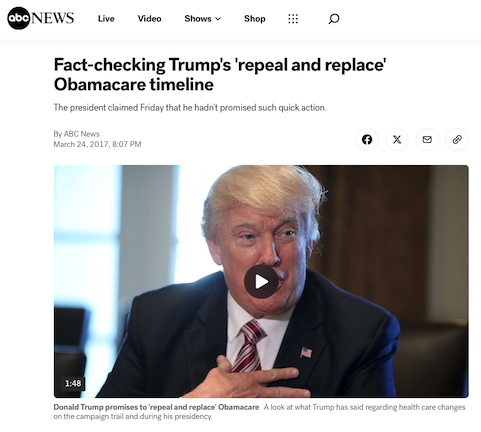
During the campaign in 2016, Trump said that, “On day one of the Trump Administration, we will ask Congress to immediately deliver a full repeal of Obamacare. . . . My first day in office, I am going to ask Congress to put a bill on my desk getting rid of this disastrous law and replacing it with reforms that expand choice, freedom, affordability:” Fact-checking Trump’s ‘repeal and replace’ Obamacare timeline – ABC News.
In 2019, Trump’s continued yapping about health care included his announcement that there would be a “phenomenal” new plan: Trump vows ‘phenomenal’ new health care plan – ABC News. In fact, not only was there never any “phenomenal” new plan, there was no plan at all. As ABC News dug into the issue, even senior White House officials admitted being far from putting together an actual health care bill.
As Trump’s first term neared its end, Trump teased the country about a new health care plan. In July 2020, he commented during an interview that “We’re signing a health care plan within two weeks, a full and complete health care plan that the Supreme Court decision on DACA gave me the right to do.” At another point, he said that “Over the next two weeks, I’ll be pursuing a major executive order requiring health insurance companies to cover all pre-existing conditions for all customers. That’s a big thing. I’ve always been very strongly in favor – we have to cover pre-existing conditions. So we will be pursuing a major executive order, requiring health insurance companies to cover all pre-existing conditions for all of its customers:” Trump promised a health care plan before the end of August. It never came. | CNN Politics. Despite all his pronouncements, nothing ever came of all of the blathering rhetoric about health care.
While the GOP controls the White House and Congress today, the plan that has come to light is obvious: strip Americans of the ability to get affordable health care. There never was a plan and they will seemingly never work on and deliver a detailed plan. The GOP talks and, sadly, millions listen to the lies about a future plan that will never exist.
As the 2026 health care enrollment period begins, sticker shock is a polite way of describing the initial premiums people are seeing for their plans: Obamacare enrollees get first look at 2026 prices as premiums soar | CNN Politics. The decade long talk from Trump and the GOP is no longer just talk. They are exposed as having no real concern to fix anything related to health care costs as their history of inaction suggests. This issue, perhaps more than most, underscores what or who Trump and the GOP care about: the rich and super-rich, not the average person.
While many despise her, it seems that the person who accurately explained the situation is none other than Nancy Pelosi who said, “The American people already know exactly what the President’s health care plans mean in their lives: higher costs, worse coverage and the end of lifesaving protections for people with pre-existing conditions:” Trump vows ‘phenomenal’ new health care plan – ABC News. The political party that espouses the importance of a pro-life line item in its platform demonstrates the issue’s irrelevance in its day-to-day conduct. Providing life-saving health care is just political babble to them.

Photo by AnnaGibbs.com
About the Timothy Trainer: Writing books is a passion for attorney Timothy Trainer, who for more than three decades focused on intellectual property issues in his day job. He has worked in government agencies and in the private sector and his assignments have taken him to 60 countries around the world.
Tim found time to pen a few non-fiction tomes, including his first book, Customs Enforcement of Intellectual Property Rights; the 15th edition was published in 2022. Thomson Reuters’ Aspatore Books published Tim’s next title in 2015, Potato Chips to Computer Chips: The War on Fake Stuff.
Fiction was a genre he always wanted to try. In 2019, Pendulum Over the Pacific, was released by Joshua Tree Publishing. “This political intrigue story is set in Tokyo and Washington, D.C., and centers on trade tensions between the U.S. and Japan in the late 1980s,” Tim explains.
In 2023, his first series hit bookstores: The China Connection.
In 2025, he published the sequel, The China Factor, which ranked #63 on the Amazon Asian Literature list in May.
“Demolition and Demise: It’s too late to reverse the damage and demolition to the White House. Is it too late to save the constitution and democracy?,” asks IP attorney and award-winning author Timothy Trainer
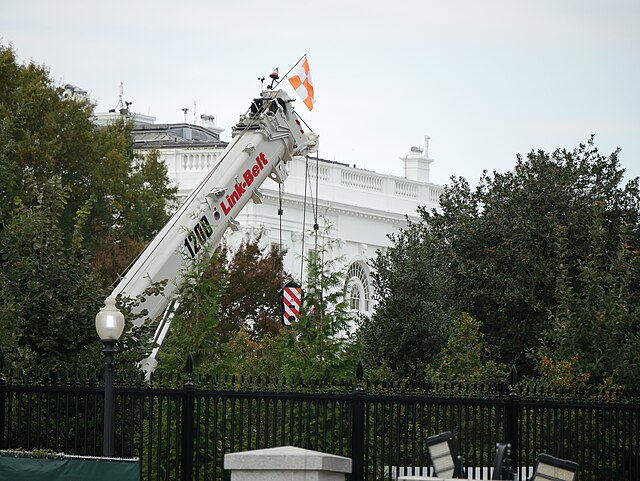
The East Wing of the White House is demolished for a grand ballroom. The demolition of any part of the White House is, at this point, beyond symbolic of the destruction of the United States as many of us have known it. Trump, his cabinet members, and those elected GOP members in Congress have exposed themselves regarding the extremes they are willing to accept to change the country.
We’ve known for quite some time that the GOP’s favorite color is white. Simply consider the recent moves regarding who will be considered as refugees and allowed to enter the country: Trump Considers Overhaul of Refugee System That Would Favor White People – The New York Times.
One of Trump’s earlier acts, the removal of the Chairman of the Joint Chiefs of Staff General CQ Brown, is another example given the fact that there was nothing regarding General Brown’s performance as the Chairman that caused his removal other than the fact that he is African-American: Trump fires chairman of the Joint Chiefs of Staff Gen. Charles Q. Brown Jr., NPR. It’s more likely that Defense Secretary Hegseth couldn’t accept the possibility that a man of color was a successful fighter pilot and climbed the ladder of military success on his own, something the SecDef seems to have been unable to accomplish.
House speaker Johnson characterizes those demonstrating on “No Kings Day” as a hate America rally: Johnson describes planned No Kings rally as ‘hate America,’ ‘pro-Hamas’ gathering – POLITICO. Puppet Johnson receives his $223,500 taxpayer salary to be a compliant follower and receives an additional $50,000 for personal allowances for things related to his official duties. As he cowardly says only what Trump tells him to say, other Americans exercised something Johnson and Trump no longer believe in for others: free speech. In the eyes of the spineless elected GOP members, only Trump is allowed to express opinions (facts are beyond him).
Trump cuts off trade negotiations with Canada because he’s upset that an advertisement in Canada featured the late President Reagan speaking about the negative effects of tariffs: Trump Says He’s Cutting Off Trade Negotiations With Canada – The New York Times. Of course, we should not forget that Trump (and his minions) has continued his China antics for months, leading to U.S. soybean farmers selling ZERO soybeans to China in September. China imports no US soybeans in September for first time in seven years. September was also notable for China’s curbing of exports of rare earth magnets to the United States by nearly 29%. Fall in China’s exports of rare earth magnets stokes supply chain fears. These magnets aren’t very important unless one believes they make life convenient, as they are used in earbuds, cell phones, hard disk drives, electric vehicles, wind turbines, MRI machines, and a host of U.S. weapons systems.
While Trump and his followers like to project an image of supporting the military and veterans, this is just a reminder that it is Trump’s people who sought to delay consideration of disability benefits. As applications for benefits pile up, this administration tried to use the government shutdown as an excuse to delay consideration of submissions for disability benefits. Fortunately, the panel that hears such requests denied the Trump Administration’s arguments for further delay, voting 9-0 against the Trump Administration’s request: US court rejects Trump officials’ effort to delay rulings on veterans benefits | Trump administration | The Guardian.
It’s too late to reverse the damage and demolition to the White House. We see daily that elected GOP members are not in their elected positions to protect and defend the Constitution. The question that is before the country is whether it’s already too late to save the constitution and democracy that once existed in the United States.
Image by: Sizzlipedia, Wikimedia Commons
Photo by AnnaGibbs.com
About the Timothy Trainer: Writing books is a passion for attorney Timothy Trainer, who for more than three decades focused on intellectual property issues in his day job. He has worked in government agencies and in the private sector and his assignments have taken him to 60 countries around the world.
Tim found time to pen a few non-fiction tomes, including his first book, Customs Enforcement of Intellectual Property Rights; the 15th edition was published in 2022. Thomson Reuters’ Aspatore Books published Tim’s next title in 2015, Potato Chips to Computer Chips: The War on Fake Stuff.
Fiction was a genre he always wanted to try. In 2019, Pendulum Over the Pacific, was released by Joshua Tree Publishing. “This political intrigue story is set in Tokyo and Washington, D.C., and centers on trade tensions between the U.S. and Japan in the late 1980s,” Tim explains.
In 2023, his first series hit bookstores: The China Connection.
In 2025, he published the sequel, The China Factor, which ranked #63 on the Amazon Asian Literature list in May.
Read“Women: The Other Half (Maybe More),” by author Timothy Trainer

In the days and weeks following the murder of Charlie Kirk, those active on social media and the news reporting industry have provided massive amounts of information and opinion.
Much of what has been said and written is simply noise, easy to overlook. One issue that raised my curiosity and prompted a little “research” was the issue of women in the workplace as opposed to being stay-at-home wives/moms. This one is particularly difficult to let go of, along with many other issues that have been raised.
The discussion or debate about women is an interesting topic. Historically, women were sidelined, kept behind a wall and prevented from doing many things, including things as basic as pursuing an education, entering various occupations, and voting. As a result, it’s ear-piercing to hear anyone talk about the role of women and expressing a desire to return to the past.
With the issue raised, it was worth finding some statistics about where we are. It’s important to know where we are today and how today’s situation might affect the future.
Multiple sources point to the fact that women are taking education more seriously than their male counterparts. A Forbes article reported that nationally women make up 58% of all college students and by 2021 there were approximately three million more women in college than men: Women Continue To Outpace Men In College Enrollment And Graduation. The Forbes report looked at other sources and noted that this phenomenon of more women in college than men was the case in all 50 states and that in 13 states the women made up at least 60% of college students.
The situation is the same or worse, depending on your viewpoint, at the level of graduate studies, where women earned nearly 63% of master’s degrees: College Enrollment Statistics [2025]: Total + by Demographic. The legal profession has seen a significant change in the proportion of women pursuing and obtaining law degrees. Since 2019, more women than men have earned law degrees every year, and the gap is growing: Women in the Legal Profession. In 2023, approximately 55% of law school graduates were women.
Academic areas where women have not yet caught up are in physical and earth sciences, mathematics and computer sciences, and engineering: STEM Statistics: Higher Education | National Girls Collaborative Project. Perhaps it is simply a matter of time. Women do earn a majority of bachelor’s degrees in psychology, biological sciences, and social sciences.
For some, the return to the past may look attractive, though unrealistic. It seems a silly debate and notion to tell anyone, male or female, to sit back and not exercise one’s intellectual capabilities to the fullest in their areas of interest. Are women succeeding in the halls of academic institutions because they are more motivated than their male counterparts? If women are more willing to learn, self-motivate and succeed, not only do they as individuals benefit, but society benefits given the diverse areas they will enter when they move into the work force.
It is a preposterous idea to tell half of the human species to forego their ambitions, put aside their curiosity and not work toward fulfillment. Given these statistics, it’s hard to accept any argument that men are having their jobs taken from them if they aren’t motivated enough to take their education seriously and fill the positions that require a greater level of learning.
Ultimately, we should be celebrating the fact that where men seem to have lost their motivation to pursue education at higher levels, women have stepped in and stepped up.
Photo by AnnaGibbs.com
About the Timothy Trainer: Writing books is a passion for attorney Timothy Trainer, who for more than three decades focused on intellectual property issues in his day job. He has worked in government agencies and in the private sector and his assignments have taken him to 60 countries around the world.
Tim found time to pen a few non-fiction tomes, including his first book, Customs Enforcement of Intellectual Property Rights; the 15th edition was published in 2022. Thomson Reuters’ Aspatore Books published Tim’s next title in 2015, Potato Chips to Computer Chips: The War on Fake Stuff.
Fiction was a genre he always wanted to try. In 2019, Pendulum Over the Pacific, was released by Joshua Tree Publishing. “This political intrigue story is set in Tokyo and Washington, D.C., and centers on trade tensions between the U.S. and Japan in the late 1980s,” Tim explains.
In 2023, his first series hit bookstores: The China Connection.
Watch Listen to the podcast on Inkandescent Radio
October 2025: Ep6 Tim’s Travails — Meet GW Law Professor Mark Traphagen, the U.S. contributing author to the legal treatise, “Copyright Throughout the World”
October 2025 — Artificial Intelligence and its impact on labor is the topic of this month's episode of Tim's Travails, where Tim and GW law professor Mark Traphagen discuss how AI impacts the creative/entertainment industries, including several recent developments: Anthropic's decision to pay out $1.5 billion for downloading thousands of books in violation of copyright law and the required human element to claim copyright to authored works. Don't miss it!
Read
Listen to the podcast on Inkandescent Radio
October 2025: Ep6 Tim’s Travails — Meet GW Law Professor Mark Traphagen, the U.S. contributing author to the legal treatise, “Copyright Throughout the World”
October 2025 — Artificial Intelligence and its impact on labor is the topic of this month's episode of Tim's Travails, where Tim and GW law professor Mark Traphagen discuss how AI impacts the creative/entertainment industries, including several recent developments: Anthropic's decision to pay out $1.5 billion for downloading thousands of books in violation of copyright law and the required human element to claim copyright to authored works. Don't miss it!
Read
October 2025: Ep6 Tim’s Travails — Meet GW Law Professor Mark Traphagen, the U.S. contributing author to the legal treatise, “Copyright Throughout the World”

October 2025 — This month on IP attorney and author Timothy Trainer’s podcast/video show we meet GW Intellectual Property Law Professor Mark Traphagen
Our topic: Artificial Intelligence and its impact on labor, with a focus on how AI impacts the creative/entertainment industries, including several recent developments:
- Anthropic’s decision to pay out $1.5 billion for downloading thousands of books in violation of copyright law
- The required human element to claim copyright to authored works
About our guest: Mark Traphagen is the U.S. contributing author to the legal treatise Copyright Throughout the World, and has taught international and co mparative intellectual property law at the George Washington University Law School and the Munich Intellectual Property Law Center, a consortium that includes the Max Planck Institute for Innovation and Competition. After starting his legal career with the U.S. Patent and Trademark Office and Finnegan Henderson LLP, Mr. Traphagen represented what is now the Software and Information Industry Association in negotiations for the WIPO Copyright Treaty and Congressional enactment of the Digital Millennium Copyright Act. He also advised clients about the implementation and enforcement of the WTO TRIPS Agreement and prepared submissions for the annual “Special 301” review by the U.S. Trademark Representative. Today, Mr. Traphagen is the principal of Traphagen Law PLLC, where he practices in the fields of copyright and trademark, entertainment and sports law, advertising and promotions, and privacy and data security. Click here to get LinkedIn with Mark.
About Copyright Throughout the World: Edited by an internationally recognized expert in copyright law, Copyright Throughout the World is a guide to the copyright law of more than 30 nations. This three-volume set is useful for copyright practitioners working with the internet and other media and for academics researching comparative laws. It analyzes the important features of copyright law, related rights, and moral rights from countries throughout the world. Topics covered permit easy comparison of the laws of different countries. Learn more here.

Photos of Tim by AnnaGibbs.com
About Tim’s Travails: In this podcast/video sereis, IP attorney and author Tim Trainer introduce us to experts around the country who have insight into the law, international trade, and more, to help us better understand our world in 2025 and beyond.
Tim, himself, fits the bill for he worked for three decades for the US government and private law firms focusing on international trade, and has developed a deep understanding of global economics and politics.
Writing books is his passion. The author of seven books as of 2025, he has penned several non-fiction tomes, including his first book, Customs Enforcement of Intellectual Property Rights; the 15th edition was published in 2020. Thomson Reuters’ Aspatore Books published Tim’s next title in 2015, Potato Chips to Computer Chips: The War on Fake Stuff. Fiction was a genre he always wanted to try. In 2017, Pendulum Over the Pacific was released by Joshua Tree Publishing. “This political intrigue story is set in Tokyo and Washington, D.C., and centers on trade tensions between the U.S. and Japan in the late 1980s,” Tim explains. In 2023, his first series hit bookstores: The China Connection. In December 2024, he followed it with The China Factor.
Stay tuned for more episodes on InkandescentRadio.com and Inkandescent.tv, and of course, log in regularly for new blog entries and other information on Tim’s website, www.TimothyTrainer.com.
ReadThe Military Writers Society of America honors Timothy Trainer’s third novel, ‘The China Factor,’ with its Bronze Award
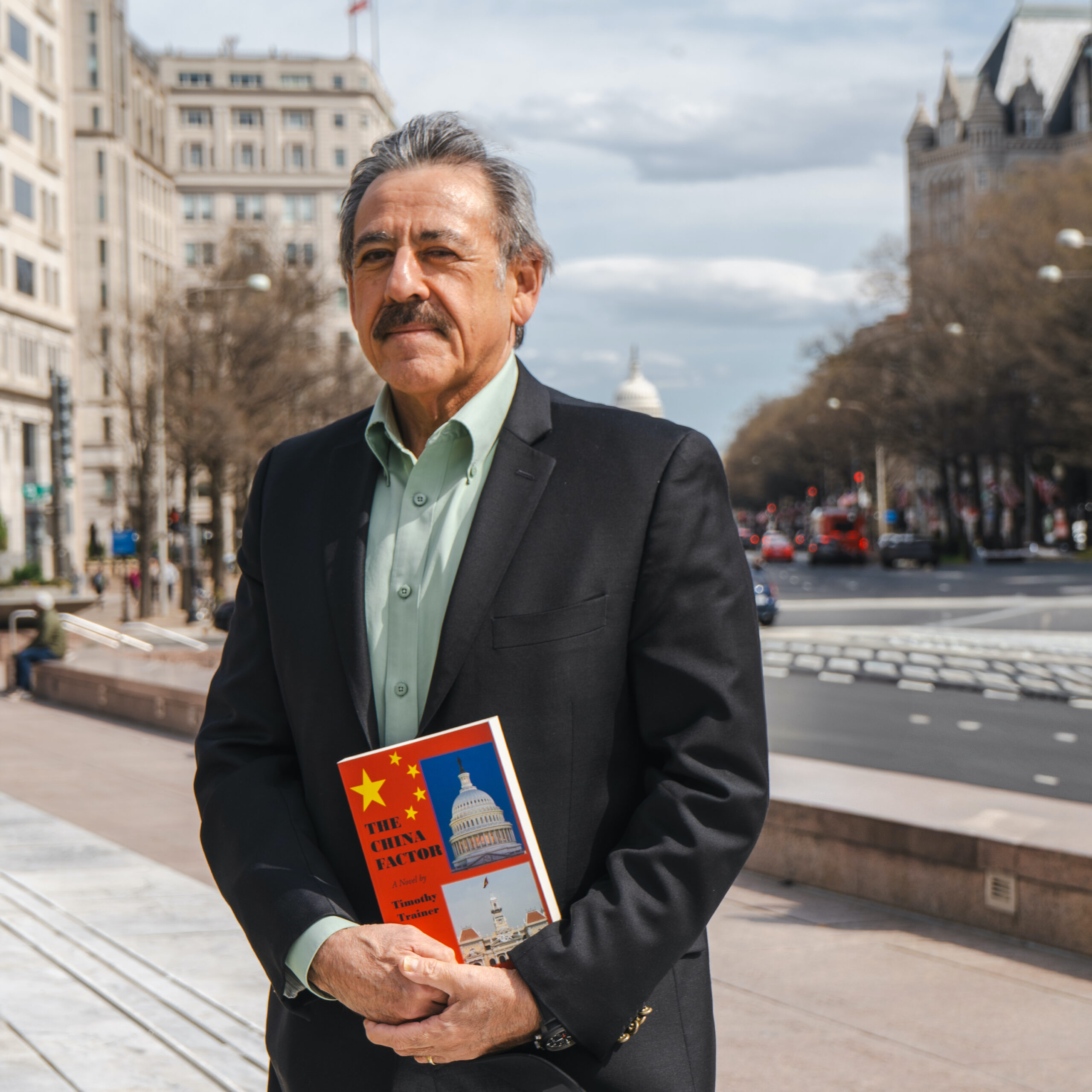
WASHINGTON, DC, UNITED STATES, September 28, 2025 /EINPresswire.com/ — The Military Writers Society of America (MWSA) announced on September 27, 2025, that Timothy Trainer’s third novel, The China Factor, received the Bronze Award in MWSA’s Mystery, Thriller, Crime fiction category: mwsadispatches.com/2025-season.
Ranked this year as high as #63 for Asian Literature on Amazon.com, his latest book comes on the heels of The China Connection, which received a 2024 Bronze Award from the MWSA in the same category. The China Factor is available at amazon.com.
About the book: The China Factor highlights economic friction between the United States and its economic adversaries as the driving force behind the stories. It takes readers from Washington, D.C., and Ho Chi Minh City (formerly Saigon), unfolding as the FBI thwarts the exchange of stolen information to a Chinese diplomat. Having stopped one attempt, the investigation targets the person providing the information that China had previously received.
What critics are saying: A reviewer at the Military Writers Society of America wrote that the new book “is an intriguing, well-told tale with many twists. The time frame is Spring 2005, and characters are found on Capitol Hill in Washington, D.C., as well as Vietnam.”
What fans are saying: “The China Factor digs into economic and trade competition between China and the U.S. and the tensions arising from that competition. People and governments engage in illegal activity to gain advantages,” says journalist and author Hope Katz Gibbs, founder of the Inkandescent PR + Publishing Co. “Tim has set the book in 2005, but this story is straight out of today’s headlines. Reading this novel, the reader experiences what might occur behind the scenes in the real world.”
She adds that because The China Factor exposes readers to how the Chinese plan to use the stolen information in its commercial pursuits in Vietnam, the book teaches a powerful history lesson. “Tim weaves together the stories of international trade intrigue and personal misgivings from years past through his characters,” she shares, noting, “If you’ve been paying attention to recent headlines, the idea that Vietnam is caught between two world powers will ring true. The China Factor resonates in today’s world.”
Trainer explains that taking real-world tensions that exist and playing with possibilities is a fun and challenging exercise. “In addition to the usual military considerations, there are the economic and trade elements in these relationships that can be explored and exploited.”
Stay tuned for more books by Trainer. Be sure to review his website filled with his weekly column that is also published on Substack, and his monthly video show Tim’s Travails is on YouTube; his podcast is featured on Spotify, Apple and iHeart Radio.

About the Timothy Trainer: Writing books is a passion for attorney Timothy Trainer, who for more than three decades focused on intellectual property issues in his day job. He has worked in government agencies and in the private sector and his assignments have taken him to 60 countries around the world.
Tim found time to pen a few non-fiction tomes, including his first book, Customs Enforcement of Intellectual Property Rights; the 15th edition was published in 2022. Thomson Reuters’ Aspatore Books published Tim’s next title in 2015, Potato Chips to Computer Chips: The War on Fake Stuff.
Fiction was a genre he always wanted to try. In 2019, Pendulum Over the Pacific, was released by Joshua Tree Publishing. “This political intrigue story is set in Tokyo and Washington, D.C., and centers on trade tensions between the U.S. and Japan in the late 1980s,” Tim explains.
In 2023, his first series hit bookstores: The China Connection.
In 2025, he published the sequel, The China Factor, which ranked #63 on the Amazon Asian Literature list in May.
Read“Judges and Lawyers: The Right Thing to Do,” by IP attorney and award-winning author Timothy Trainer
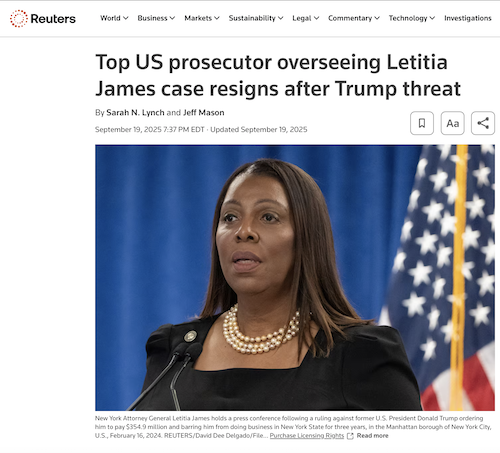
Two recent events occurred that highlighted the work and responsibilities of judges and lawyers. A lawyer resigned knowing he was about to be fired. A federal judge tossed a case by strongly suggesting that lawyers acting on behalf of their client, the President, reread the rules regarding what should be in a complaint to initiate a lawsuit.
Unlike television dramas, the real practice of law can be tedious. There’s a lot of sifting through information. That information might be factual, anecdotal, opinions or something wholly different. In Virginia, Erik Siebert, U.S. Attorney for the Eastern District of Virginia, resigned after hearing that the President was unhappy that he had not filed charges against those the President believes need to be prosecuted.
It isn’t as if Mr. Siebert is soft on crime. His background includes several years as a police officer before pursuing his law degree. Eastern District of Virginia | Meet the U.S. Attorney | United States Department of Justice. Since graduating from law school, Mr. Siebert has practiced criminal law for the Justice Department where he has prosecuted cases since 2010. His demise as the appointed U.S. Attorney is reportedly due to doing something fundamental to the work of an ethical attorney: weighing the evidence and determining whether the evidence supports a criminal prosecution.
Siebert’s failure to initiate cases against New York Attorney General Letitia James and former FBI Director James Comey became an issue for the White House. Top US prosecutor overseeing Letitia James case resigns after Trump threat | Reuters. It seems that Siebert expressed his reservations about the evidence in the cases against the two that are in Trump’s crosshairs. Siebert fell into disfavor because, well, he was doing what a responsible and ethical prosecutor should do: determine whether sufficient evidence exists to criminally prosecute someone, anyone. Doing the right thing is not at all acceptable to Trump and, therefore, the prosecutor who engaged in the kind of evaluation we should expect and demand before any person is subjected to a criminal charge had to go.
In another case, Federal Judge Merryday dismissed Trump’s 85-page defamation complaint against The New York Times. In his four-page ruling, the judge underscored the basics to Trump’s lawyers regarding what the point of a complaint is and isn’t. gov.uscourts.flmd.447437.5.0.pdf. The judge explained that Trump’s complaint was not the proper place to “rage against an adversary”. He wrote that “A complaint is a mechanism to fairly, precisely, directly, soberly, and economically inform the defendants — in a professionally constrained manner consistent with the dignity of the adversarial process in an Article III court of the United States — of the nature and content of the claims. A complaint is a short, plain, direct statement of allegations of fact sufficient to create a facially plausible claim for relief and sufficient to permit the formulation of an informed response”.
Essentially, the judge reminded Trump’s legal counsel that there is a clear and distinct difference between a legal filing and a political rant of displeasure toward people the president targets. Most of the judge’s four pages seemed aimed at Trump’s lawyers, reminding them of the decorum expected of officers of the court.
These developments should serve as a reminder to everyone about the role of legal counsel and the judiciary. A lawyer’s zealous representation of a client does not mean straying from his or her legal and ethical responsibilities before a court. Mr. Siebert’s decision-making process of weighing evidence before deciding whether to prosecute is admirable because it was the right thing to do. Judge Merryday’s dismissal of Trump’s complaint was also the right thing to do while giving the would-be plaintiff time to amend and refile the complaint in accordance with the rules.
We have arrived at a point and a time when those who do the right thing, who still respect the rule of law, and the U.S. legal system, try to prevent the dismantling of a system that helped make the United States a great nation. While Trump and a number of his appointees are intent on violating the laws of these United States, we need judges and other officers of the court to live up to their oaths, remain committed to the rule of law, and act accordingly even when those holding the highest offices in the country refuse to do so.
 About the Timothy Trainer: Writing books is a passion for attorney Timothy Trainer, who for more than three decades focused on intellectual property issues in his day job. He has worked in government agencies and in the private sector and his assignments have taken him to 60 countries around the world.
Tim found time to pen a few non-fiction tomes, including his first book, Customs Enforcement of Intellectual Property Rights; the 15th edition was published in 2022. Thomson Reuters’ Aspatore Books published Tim’s next title in 2015, Potato Chips to Computer Chips: The War on Fake Stuff.
Fiction was a genre he always wanted to try. In 2019, Pendulum Over the Pacific, was released by Joshua Tree Publishing. “This political intrigue story is set in Tokyo and Washington, D.C., and centers on trade tensions between the U.S. and Japan in the late 1980s,” Tim explains.
In 2023, his first series hit bookstores: The China Connection.
In 2025, he published the sequel, The China Factor, which ranked #63 on the Amazon Asian Literature list in May.
Read“Department of War or Defense: Beyond the Name,” by IP attorney Timothy Trainer, author “The Fortunate Son”
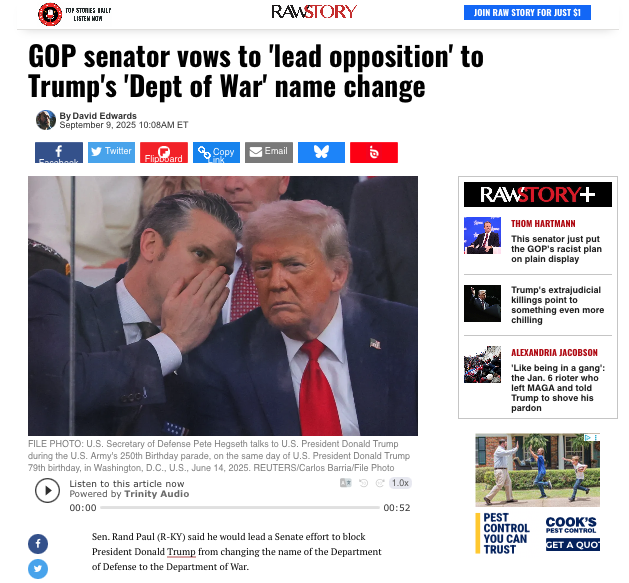
Whether the name is changed officially or not, we will now hear the administration refer to the Department of War for the remainder of this term. The website www.defense.gov now converts to www.war.gov. Interestingly, Kentucky’s Senator Rand Paul has stated that he opposes a formal change and would work to oppose such a change. rawstory.com.
The United States has had an all-volunteer military since 1973. We’ve heard or read repeatedly that the Secretary of Defense (War) wants a more warrior ethos projected by our serving military members. As this administration seeks to generate an image of U.S. forces as more… war-capable, it seems fitting to ask: who are these warriors? Ironically, within days of announcing the change, referring to the Department of War, USA Today published an article on September 6th on the challenges of recruitment.
For those who are interested in knowing something about the volunteer force, it might be surprising or frightening or confusing to read the headline: “Once these recruits couldn’t make the cut. Now they make up a quarter of Army troops,” usatoday.com. Finding young men and women who meet current enlistment standards isn’t always easy. There are both minimum academic and physical requirements to join the army.
According to the USA Today article, the army maintains a Future Soldier Preparatory Course to help those wanting to enlist to attain the minimum standards so that they can become actual army enlistees. The article reports that it will cost over $200 million this year and next to help people reach the minimum academic and physical standards set to become a “real” army trainee.
USA Today reports that a Defense Department Inspector General report found the Future Soldier course admitted trainees with body fat “far above its stated cap” and “the program’s academic component had also let its stated standards slide”. As unfortunate as these findings might be, the Inspector General’s report also stated that “a significant portion had difficulty speaking or understanding English.” The Defense Department report is dated May 1, 2025, media.defense.gov. The Defense Department report highlights how the Army has not adhered to its own rules regarding assessments of those in the Future Soldier course in order to allow participants to enlist.
 Generally, over the past 50 years, the government has praised the performance of the all-volunteer force. As citizens and taxpayers, this report, which is not read by many, should raise concerns about the force we rely upon for national defense (war-fighting).
If nearly a quarter of all troops in the U.S. Army come from this pool of enlistees, are the personnel specialists at the Pentagon ignoring a serious problem? If nearly a quarter of the troops have physical, academic, or language deficiencies, are they able to properly use systems that increasingly incorporate technology? Today’s soldiers are equipped with technology that didn’t exist 15 or 20 years ago. When one reads that soldiers today have mapping tools, night vision devices, and helmet-mounted technology, is the array of new equipment usable by those recruited from the prep course? All the high-tech gear the Army is bringing to soldiers. It isn’t enough to say that they are able to learn to use them in training situations. The requirement will be for these recruits to act and think instinctively if deployed to a combat zone.
All the individualized technology is fine as long as the conditions allow for their use. Anyone who has ever spoken to people who have been in combat will quickly learn that training cannot simulate the real thing. As an example, something as fundamental as map reading might become a necessity when technology fails. What happens when some or all that technology is ineffective?
There’s nothing surprising to read or hear that the Trump Administration wants a name change to the Department of Defense. The administration wants a Department of War. It needs to project masculinity, strength and power. The talk, the chatter, the words all seem to do something else: expose Trump and Hegseth as being examples of frail male egos. Instead of image projection, the United States would be better served if those looking at personnel requirements engaged in an honest assessment of the army’s personnel needs, made the appropriate changes, and dedicated more effort to attract those who meet the minimum standards without the need for special courses.
About the Timothy Trainer: Writing books is a passion for attorney Timothy Trainer, who for more than three decades focused on intellectual property issues in his day job. He has worked in government agencies and in the private sector and his assignments have taken him to 60 countries around the world.
Tim found time to pen a few non-fiction tomes, including his first book, Customs Enforcement of Intellectual Property Rights; the 15th edition was published in 2022. Thomson Reuters’ Aspatore Books published Tim’s next title in 2015, Potato Chips to Computer Chips: The War on Fake Stuff.
Fiction was a genre he always wanted to try. In 2019, Pendulum Over the Pacific, was released by Joshua Tree Publishing. “This political intrigue story is set in Tokyo and Washington, D.C., and centers on trade tensions between the U.S. and Japan in the late 1980s,” Tim explains.
In 2023, his first series hit bookstores: The China Connection.
In 2025, he published the sequel, The China Factor, which ranked #63 on the Amazon Asian Literature list in May.
Learn more about this book and Tim’s writing process when he’s interviewed by author Jeffrey James Higgins’ for his new Inkandescent podcast and video show: Elaine’s Literary Salon.
Learn about Tim’s work and books: timothytrainer.com
Watch Listen to the podcast on Inkandescent Radio
September 2025: Ep5 Tim’s Travails — Meet Chun T. Wright, law firm owner and former Assistant U.S. Attorney in the District of Columbia
September 2025: Chunnie traveled to over 60 countries and built a legal practice that covers copyright, trademark, technology and even something called “adventure travel law.” Tim asks her, "How did you create such a unique mix and what is the common thread?"
Read
Listen to the podcast on Inkandescent Radio
September 2025: Ep5 Tim’s Travails — Meet Chun T. Wright, law firm owner and former Assistant U.S. Attorney in the District of Columbia
September 2025: Chunnie traveled to over 60 countries and built a legal practice that covers copyright, trademark, technology and even something called “adventure travel law.” Tim asks her, "How did you create such a unique mix and what is the common thread?"
Read
September 2025: Ep5 Tim’s Travails — Meet Chun T. Wright, law firm owner and former Assistant U.S. Attorney in the District of Columbia

September 2025 — This month on IP attorney and author Timothy Trainer’s podcast/video show we meet Chun T. Wright, law firm owner and former Assistant U.S. Attorney in the District of Columbia
This month’s topic: The adventure of travel law
Tim asks Chunnie:
- You’ve built a legal practice that covers copyright, trademark, technology and even something called “adventure travel law.” How did you create such a unique mix and what is the common thread
- You have traveled to over 60 countries, how did that happen?
- Out of all those adventures, what are one or two trips that really stand out as unusual, challenging or unforgettable?
- Did your travel and outdoor activities lead you into Adventure Travel?
- What is Adventure Travel law?
- For entrepreneurs and companies listening—whether they’re building cutting-edge tech or leading people up mountains—what’s one piece of legal advice you wish everyone knew?
About our guest: Chun (Chunnie) Wright is the owner of the Law Office of Chun T. Wright, a Washington, DC-based boutique law firm. The firm’s practice areas include intellectual property protection and enforcement (trademark and copyright), technology law, and adventure travel law.
Chunnie has been a litigator at major law firms in San Francisco and the Silicon Valley, a federal prosecutor in Washington, DC, and vice president of anti-piracy legal affairs at the Entertainment Software Association, which is the trade association for the video game industry. Chunnie is the Vice Chair and incoming Chair of the International Trademark Association’s Enforcement Committee. Chunnie is also on the Executive Committee of the AUSA Association-DC and on various boards, including the Adventure Travel Trade Association, BirdNote, and the Reef Environmental Education Foundation.
She received her BBA from the University of Texas at Austin and her JD from the University of California Berkeley School of Law. She is an avid scuba diver and traveler who has visited over 60 countries. Learn more here: ctwrightlaw.com
Photos of Tim by AnnaGibbs.com
About Tim’s Travails: In this podcast/video sereis, IP attorney and author Tim Trainer introduce us to experts around the country who have insight into the law, international trade, and more, to help us better understand our world in 2025 and beyond.
Tim, himself, fits the bill for he worked for three decades for the US government and private law firms focusing on international trade, and has developed a deep understanding of global economics and politics.
Writing books is his passion. The author of seven books as of 2025, he has penned several non-fiction tomes, including his first book, Customs Enforcement of Intellectual Property Rights; the 15th edition was published in 2020. Thomson Reuters’ Aspatore Books published Tim’s next title in 2015, Potato Chips to Computer Chips: The War on Fake Stuff. Fiction was a genre he always wanted to try. In 2017, Pendulum Over the Pacific was released by Joshua Tree Publishing. “This political intrigue story is set in Tokyo and Washington, D.C., and centers on trade tensions between the U.S. and Japan in the late 1980s,” Tim explains. In 2023, his first series hit bookstores: The China Connection. In December 2024, he followed it with The China Factor.
Stay tuned for more episodes on InkandescentRadio.com and Inkandescent.tv, and of course, log in regularly for new blog entries and other information on Tim’s website, www.TimothyTrainer.com.
Read“Emotional Divisiveness: The Flag,” by Timothy Trainer, author, “The Fortunate Son”

Bad policies? Bad poll numbers? Increasing prices? Is it time to find another issue to divide the people? Or is this the one to rally everyone behind something? Did the busy people in the White House huddle and decide that an Executive Order about flag burning would be an easy win with fist-pumps and chest pounding all around?
Red, white and blue, the colors of our flag are not at all unique. Twenty-nine countries have national flags comprised of the same red, white and blue colors. Countries With Red, White And Blue Flags – WorldAtlas.
It’s a wonderful political ploy. Flag burning annoys, angers and incites people. Who would disagree that the flag is a cherished symbol? Who disagrees that burning the flag is offensive and provocative?
The question is why does flag burning cause this reaction? Beyond a piece of cloth that indicates that the “stars and stripes” is our flag, what is behind the symbolism? Is it because it conjures up images of brave and courageous soldiers, sailors, airmen and marines who have carried and hoisted the flag in battle? Is it because we embrace freedom of religion, freedom of expression, freedom of the press guaranteed by the constitution? Is it because it represents progress through the extension of voting rights to women and people of color? Is it because, in theory, we live in a country that delivers equal treatment to all (a concept still questionable in today’s USA)? Is it because of the high standard of living our economy has delivered? Is it because we have, thus far, enjoyed a country that provides what is considered decent basic education capped by some of the best universities in the world?
The United States has witnessed many ways that citizens express displeasure with government policies or conduct as well as discriminatory policies. In 1948, “Edna Griffin organized a boycott, conducted sit-ins, and picketed in front of the store every Saturday for two months, demanding an end to race-based refusal of service.” She eventually won her legal case based on the Iowa Civil Rights Act. The Little Known History of Black Women Using Soda Fountains as Contested Spaces – AAIHS. Rosa Parks’ refusal to give up her seat on a bus to white passengers was a peaceful, quiet act to defy discriminatory policies. Rosa Parks | Biography, Accomplishments, Quotes, Family, & Facts | Britannica. It required decades of effort, including picketing and demonstrating in front of the White House for women to gain the right vote in the United States. Women’s Suffrage | Voters and Voting Rights | Presidential Elections and Voting in U.S. History | Classroom Materials at the Library of Congress | Library of Congress.
Essentially, various types of conduct have displayed citizens’ displeasure at practices or policies deemed not just unacceptable but wrong. Flag burning occurred numerous times at anti-war demonstrations during the Vietnam War. It was not until 1989 that the U.S. Supreme Court addressed the matter head on when a demonstrator who opposed some policies of the Reagan Administration burned the flag and was prosecuted.TEXAS, Petitioner v. Gregory Lee JOHNSON. | Supreme Court | US Law | LII / Legal Information Institute.
The Executive Order (Prosecuting Burning of The American Flag – The White House) instructs the U.S. Justice Department to “prioritize the enforcement to the fullest extent possible of our Nation’s criminal and civil laws against acts of American Flag desecration that violate applicable, content-neutral laws, while causing harm unrelated to expression, consistent with the First Amendment.” Given the Supreme Court’s decision, the Executive Order is wholly unnecessary because the Court’s decision provides a more instructive legal guide to the type of inquiry necessary to take legal action against an individual who burns the flag.
Nothing is so simple if it’s issued by this White House. When we have a White House occupant who purges women and people of color without any reason given, when he demands apologies, threatens firings, threatens investigations of individuals who he dislikes or who disagrees with him, why not target people who might burn the flag as a political statement of protest?
This Executive Order goes to the heart of what makes the United States unique in the world or has up to this point. Trump’s disdain for anyone disagreeing with him and his demand for those to fall in line with his thinking undercuts the First Amendment’s right to freedom of expression and the premise that the freedom of expression is to protect those who may possess an unpopular political view and may demonstrate their opposition to the government through the act of flag burning.
Indeed, the Supreme Court in the Texas v. Johnson case, which overturned a conviction for flag burning, emphasizes some fundamentals about the First Amendment and our freedom to express our displeasure with our government. The Supreme Court wrote that “Johnson was not, we add, prosecuted for the expression of just any idea; he was prosecuted for his expression of dissatisfaction with the policies of this country, expression situated at the core of our First Amendment values.”
The Court also stated that “If there is a bedrock principle underlying the First Amendment, it is that the government may not prohibit the expression of an idea simply because society finds the idea itself offensive or disagreeable.” Near the end of the majority’s decision, the Court wrote: ”Our decision is a reaffirmation of the principles of freedom and inclusiveness that the flag best reflects, and of the conviction that our toleration of criticism such as Johnson’s is a sign and source of our strength.”
Ultimately, it’s ironic that many will applaud this act from a man who defies the laws of these United States, who defies the courts, who violates his oath of office to protect and defend the constitution and who evaded military service. He’ll receive support by tugging at the emotional strings of citizens by attempting to undermine one of the very core rights guaranteed by the constitution and recognized as an act of political defiance and expression by the Supreme Court of the United States.
 About the Timothy Trainer: Writing books is a passion for attorney Timothy Trainer, who for more than three decades focused on intellectual property issues in his day job. He has worked in government agencies and in the private sector and his assignments have taken him to 60 countries around the world.
Tim found time to pen a few non-fiction tomes, including his first book, Customs Enforcement of Intellectual Property Rights; the 15th edition was published in 2022. Thomson Reuters’ Aspatore Books published Tim’s next title in 2015, Potato Chips to Computer Chips: The War on Fake Stuff.
Fiction was a genre he always wanted to try. In 2019, Pendulum Over the Pacific, was released by Joshua Tree Publishing. “This political intrigue story is set in Tokyo and Washington, D.C., and centers on trade tensions between the U.S. and Japan in the late 1980s,” Tim explains.
In 2023, his first series hit bookstores: The China Connection.
In 2025, he published the sequel, The China Factor, which ranked #63 on the Amazon Asian Literature list in May.
Learn more about this book and Tim’s writing process when he’s interviewed by author Jeffrey James Higgins’ for his new Inkandescent podcast and video show: Elaine’s Literary Salon.
Learn about Tim’s work and books: timothytrainer.com
Read“The Dumbing Down: FBI” by IP attorney and author Timothy Trainer
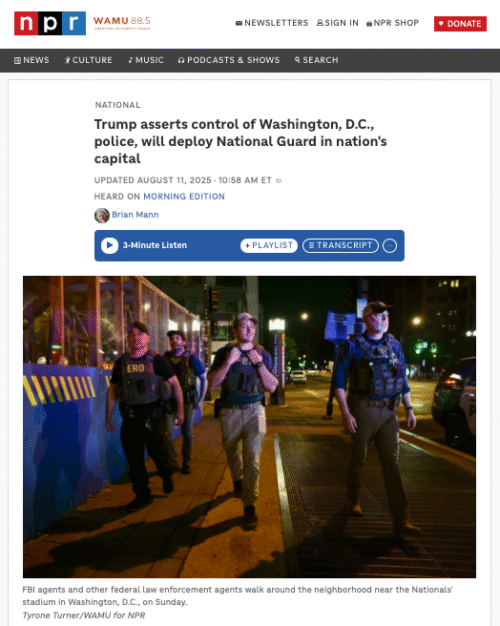
Trump’s troops walk the streets of Washington, D.C. Despite the U.S. Justice Department’s statistics indicating a decrease in violent crime (District of Columbia | Violent Crime in D.C. Hits 30 Year Low | United States Department of Justice), he wants more boots on the ground—U.S. ground. One wonders why he doesn’t do the same in Memphis, Baltimore, St. Louis and Birmingham. Highest Crime Cities in the US 2025 | Stats & Facts About Crime Cities – The Global Statistics. Perhaps it’s only a matter of time.
In addition to national guard troops, reassigning FBI agents to the streets of the nation’s capital will also occur. It’s reported that 120 FBI agents will patrol the streets of Washington, D.C. Federal agents spread out across D.C. amid Trump vow to crack down on crime : NPR. This diversion of FBI agents to the streets means fewer agents to investigate corruption and engage in counter-terrorism work. A cynic would say that by having fewer agents investigating public corruption, white collar crime and financial fraud suits the president and those who he pals around with.
More disturbing about the FBI’s increased role in street crime prevention is the report that the FBI will lower standards for future agents. F.B.I. Plans to Lower Recruiting Standards, Alarming Agents – The New York Times. The New York Times reports that future agents would receive less than half the training at the FBI Academy than their predecessors. In addition, educational standards will be lowered so that new agents will not have to have received at least a four-year college degree.
The practical effect of lowering standards is lowering the individual’s and the agency’s overall capabilities. Will the FBI have enough people who are capable of conducting complex investigations that require analytical skills? Will future agents be able to read and understand complex reports and documents that may be seized in an investigation? This is relevant given the state of U.S. education and the ability of high school graduates to read and understand content. Some data indicate that “two-thirds of American high school graduates have underdeveloped reading skills, with illiteracy being a significant factor in high school graduation rates.” How Many People Graduate High School Illiterate. Will the FBI test applicants before expending training and other resources to put a recruit through the FBI Academy?
The plan to lower standards begs the question: Why aren’t there enough applicants among the pool of college graduates? Or, given that this administration demands individuals place allegiance to the White House occupant over allegiance to the country, is it easier to mold a new agent who cares less about respecting and acting in accordance with the law and the constitution if they have a lower educational standard?
In a different time and under a different set of historical circumstances, the U.S. lowered standards during the 1960s to allow marginal men to be drafted to feed the manpower needs of the war in Vietnam. Project 100,000 increased the pool of eligible young men for military service. How a Plan to ‘Salvage’ Vietnam Recruits Ended Disastrously | HistoryNet. While many military professionals were against the lowered standards, the need for bodies prevailed. One career officer’s view of the project was that “Project 100,000 was implemented to produce more grunts for the killing fields of Vietnam. It took unfit recruits from the bottom of the barrel and rushed them to Vietnam. The result was human applesauce.”
Lowering standards to become an FBI agent is not the same as lowering standards to ship people off to war. Nevertheless, what’s at risk should not be overlooked. Will the FBI continue to conduct the types of national security-related investigations that have been done in the past and at the level of competence necessary to do the job well?
The deeds, the conduct, the hiring/firing exhibited by this administration does not demonstrate a sincere effort to protect and defend the United States. Lowered FBI standards will undermine the agency for an unknown period of time during which adversaries will test U.S. capabilities. What every person should understand is that this is a deliberate and intentional decision that weakens our security. Those making these decisions, while often wrapping themselves in the flag, enjoy projecting a patriotic image as their actions weaken the fundamental mission of the FBI.
The current trend of placing uniformed military personnel on the streets and diverting the FBI to patrolling the streets are unlikely to make the U.S. safer if we neglect other forms of criminal conduct. Who investigates complex cases of industrial espionage by our foreign adversaries? Is this a way of getting the citizenry to focus on day-to-day crimes while white collar criminals steal millions or billions by defrauding U.S. citizens with impunity?
Given the cases in which the sitting president has been found guilty of fraud, it isn’t a surprise that he and his appointees prefer law enforcement to be in the streets rather than investigating fraud schemes, other white-collar crimes or threats of conspiracy or espionage aimed at the U.S.
About the Author: Tim Trainer is an army brat. He was born into the Army in Japan and was a high school junior when his father retired from the Army. Typical of Army or military brats of the times, he had attended 10 schools by the time of his high school graduation. He did not arrive in the United States until he was past his fifth birthday. After arriving in the United States, the Army life meant living in various parts of the United States, on and off post, depending upon his father’s duty station.
He had three “tours of duty” at Ft. Knox, KY, (some elementary school, some high school, and basic training). Upon his discharge from the Army in July 1975, he left the Army behind permanently. At the time of his discharge, he was twenty-one and half years old but had spent twenty years as either an army brat or on active duty.
After the Army years, he eventually earned a law degree and moved to the Washington, D.C., area in 1987. Since moving to the Washington, D.C., area, he has worked as an attorney in federal government agencies and in the private sector. He has traveled extensively around the world, including several trips to Vietnam.
This work is evidence that his break from the Army was not “permanent.” In the late 1990s, his father, who was reuniting regularly with men he had served with in B2-7, invited him to meet the guys when they met in Washington, D.C. This led to his father’s invitation to attend a summer reunion in 2003. Since 2003, Mr. Trainer has been a regular attendee of the B2-7 reunions in Washington, D.C., and at the summer gatherings at what he calls “Camp Gast.”
Learn more about Tim and his books: TimothyTrainer.com
Read“The Money, the Guard, The Black Hole,” by IP attorney and author Timothy Trainer

Here’s to headline-grabbing stuff the past several days, along with something that doesn’t grab.
First, we have the supposed concern that advanced computer chips might give the Chinese an opportunity to catch up with the U.S. in artificial intelligence. At a time when money talks louder than usual, Trump decides that if the chip manufacturers are willing to pay to export to China, he’ll allow them to do so. Trump opens door to sales of version of Nvidia’s next-gen AI chips in China | Reuters. Although the chips that China would have access to aren’t the latest available versions, it doesn’t mean they can’t use them as a stepping stone for their own research and development. But for a price, anything is possible as long as a company is willing to pay (extorted?) for the privilege to export.
The second big headline that will bring great applause from some corners is the Presidential Memorandum on Restoring Law and Order to the Streets of the District of Columbia. Restoring Law and Order in the District of Columbia – The White House. While Trump makes some interesting comments about how bad crime is in the city, the U.S. Justice Department issued a statement in January 2025 that stated: “Total violent crime for 2024 in the District of Columbia is down 35% from 2023 and is the lowest it has been in over 30 years”. District of Columbia | Violent Crime in D.C. Hits 30 Year Low | United States Department of Justice. Interestingly, statistics available from DC’s Metropolitan Police support the report issued by the U.S. Department of Justice. District Crime Data at a Glance | mpdc. Simply put, lies to justify doing things are easier than looking at data, analyzing information and realizing that the actions being announced are not supported by any facts or evidence.
If Trump or members of Congress want to engage in the daily details of running the District of Columbia, perhaps they should resign their positions and run for mayor.
Then there’s the absence of the big, bold, flashing headline that we should know more about: Defense Industrial Base-Dependence on Foreign Suppliers. It’s the type of story that falls into a black hole with few noticing, even fewer reading and the administration having no interest in anyone seeing. A July 24, 2025, report issued by the U.S. Government Accountability Office (GAO) should have the public telling the White House to pay attention to national issues that don’t grab headlines but are the hard work of government.
This GAO report is worthy of the public’s time. When we have a government asking for a trillion in taxpayer dollars for national security, it’s a problem when the Defense Department “recognizes that there are serious national security implications for not knowing where components of the goods it procures are manufactured.” GAO-25-107283, DEFENSE INSUSTRIAL BASE: Actions Needed to Address Risks Posed by Dependence on Foreign Suppliers.
The GAO report had to be self-limiting because of the hundreds, thousands of weapons systems that make up the U.S. military arsenal. Given the limitations, the GAO examined information available regarding supply chain information related to the F-35 fighter jet. The report states that the Defense Department knows that the Federal Procurement Data System (FPDS) “does not contain complete information about F-35 suppliers. . . . FPDS does not include information on the subcontracts that the prime contractor, Lockheed Martin, enters with suppliers that provide subsystems, components, and raw materials for the aircraft. DoD, through Lockheed Martin, found that magnets included on some F-35s originated from China.” The discovery of these Chinese-origin magnates resulted in a pause in F-35 production for several months.
The same GAO report found similar deficiencies related to the Defense Department’s acquisition of microelectronics/electronic microcircuits. The report noted that the current data collection systems do not provide complete supply chain visibility.
While the GAO report was unable to look at components/parts sourcing for all U.S. weapons systems, the GAO’s inquiry on three systems exposed a massive deficiency that it states puts the U.S. at risk to potential adversaries.
While millions in the U.S. might applaud Trump’s efforts to force domestic and foreign enterprises to add to our treasury and applaud fabricating lies to place troops in the streets of U.S. cities, when will we expect the U.S. Government to GOVERN and address issues like the one identified in the GAO report? A trillion-dollar defense budget is meaningless if our adversaries can bring us to our knees by refusing to supply us with critical components for our weapons systems.
The problem identified by the GAO is one of thousands of challenges that confront the government, Congress, and the nation, yet we are treated daily to retribution politics. What we seem to be witnessing is not a government for the people, but a government for Trump.
Photo by AnnaGibbs.com
About the Timothy Trainer: Writing books is a passion for attorney Timothy Trainer, who for more than three decades focused on intellectual property issues in his day job. He has worked in government agencies and in the private sector and his assignments have taken him to 60 countries around the world.
Tim found time to pen a few non-fiction tomes, including his first book, Customs Enforcement of Intellectual Property Rights; the 15th edition was published in 2022. Thomson Reuters’ Aspatore Books published Tim’s next title in 2015, Potato Chips to Computer Chips: The War on Fake Stuff.
Fiction was a genre he always wanted to try. In 2019, Pendulum Over the Pacific, was released by Joshua Tree Publishing. “This political intrigue story is set in Tokyo and Washington, D.C., and centers on trade tensions between the U.S. and Japan in the late 1980s,” Tim explains.
In 2023, his first series hit bookstores: The China Connection.
In 2025, he published the sequel, The China Factor, which ranked #63 on the Amazon Asian Literature list in May.
Learn more about this book and Tim’s writing process when he’s interviewed by author Jeffrey James Higgins’ for his new Inkandescent podcast and video show: Elaine’s Literary Salon.
Learn about Tim’s work and books: timothytrainer.com
Watch
Listen to the podcast on Inkandescent Radio
August 2025: Ep4 Tim’s Travails — Meet Mark Cohen, former intellectual property attache at the US Embassy in Beijing
August 2025 — Tim asks Mark: What advice would you offer someone studying Chinese today? What are the challenges facing US diplomats in China on Intellectual Property? What do you see as the trajectory for US-China relations in trade and especially in Intellectual Property? Learn all about it!
Read
August 2025: Ep4 Tim’s Travails — Meet Mark Cohen, former intellectual property attache at the US Embassy in Beijing

August 2025 — This month on Mark Cohen, former intellectual property attaché at the US Embassy in Beijing
Today’s Topic: Understanding China through a Professor’s Eyes
Tim will talk with Mark about:
-
What advice would you offer someone studying Chinese today?
-
What are the challenges facing US diplomats in China on Intellectual Property?
-
What do you see as the trajectory for US-China relations in trade and especially in Intellectual Property?
About our guest: Mark Cohen is a non-resident fellow at the National Bureau of Asian Research and the University of California, San Diego. He serves as a guest professor at Renmin University (Beijing) and on the Advisory Board of the Asia Society. He previously led the Asia IP Project at the Berkeley Center for Law and Technology at Berkeley Law School, where he was responsible for teaching international trade law and researching and writing on IP issues. Previously, Cohen was Senior Counsel, China in the Office of Policy and International Affairs at the U.S. Patent and Trademark Office, after serving as a visiting professor at Fordham Law School (2011-2012). Prior to that time, he served in such functions as: Director, International Intellectual Property at Microsoft Corporation; Of Counsel to Jones Day’s Beijing office; and Senior Intellectual Property Attaché at the U.S. Embassy in Beijing (2004-2008). In total, he has over 30 years of private, public sector, in-house, and academic experience in China and transition economies, with a focus on technology trade and intellectual property.
Cohen was the first IPR Attaché posted by USPTO to handle IPR issues in a foreign country. In addition, he launched the annual “Ambassador’s IPR Roundtable,” which he co-chaired for five years, devised IPR “toolkits”, “road shows”, pro-bono programs, internal training programs for the US government and external training programs, and worked with USPTO and other US agencies to engage China and Chinese IP agencies. Cohen led a China team at USPTO consisting of 21 individuals in DC, Beijing, Shanghai and Guangzhou, China on all aspects of USPTO’s activities in China. Among his book-length publications are Antimonopoly Law and Practice in China (Oxford University Press, 2011, with Steve Harris et al.). He was also the editor of Chinese Intellectual Property Law and Practice (Kluwer Law International 1999) and has edited or published a number of online publications, including the blog www.chinaipr.com.
Mr. Cohen has taught and lectured at numerous universities in the United States, Asia and Europe. Amongst other honors, he was the recipient of the US Chamber of Commerce’s “IP Champion” award in 2014 and the Meritorious Service Award—the highest award in the U.S. civil service—from President Trump, upon the recommendation of President Obama. Mr. Cohen holds a JD degree from Columbia University (1984), an MA from the University of Wisconsin in Chinese Language and Literature (1979) and a BA from the State University of New York at Albany in Chinese Studies (1977).
Photos of Tim by AnnaGibbs.com
About Tim’s Travails: In this podcast/video sereis, IP attorney and author Tim Trainer introduce us to experts around the country who have insight into the law, international trade, and more, to help us better understand our world in 2025 and beyond.
Tim, himself, fits the bill for he worked for three decades for the US government and private law firms focusing on international trade, and has developed a deep understanding of global economics and politics.
Writing books is his passion. The author of seven books as of 2025, he has penned several non-fiction tomes, including his first book, Customs Enforcement of Intellectual Property Rights; the 15th edition was published in 2020. Thomson Reuters’ Aspatore Books published Tim’s next title in 2015, Potato Chips to Computer Chips: The War on Fake Stuff. Fiction was a genre he always wanted to try. In 2017, Pendulum Over the Pacific was released by Joshua Tree Publishing. “This political intrigue story is set in Tokyo and Washington, D.C., and centers on trade tensions between the U.S. and Japan in the late 1980s,” Tim explains. In 2023, his first series hit bookstores: The China Connection. In December 2024, he followed it with The China Factor.
Stay tuned for more episodes on InkandescentRadio.com and Inkandescent.tv, and of course, log in regularly for new blog entries and other information on Tim’s website, www.TimothyTrainer.com.
Read“From Authoritarian to Democracy” by author and IP attorney Timothy Trainer

August 6, 2025: It began disastrously for the United States. Japan’s attack on Pearl Harbor inflicted a horrible blow on the United States. Warships were sunk and badly damaged and thousands of military personnel were killed and wounded. Japan was the enemy to be defeated in the Pacific.
Today, and Aug. 9th, we observe the 80th anniversary of the use of atomic bombs dropped on Hiroshima and Nagasaki in 1945. These two events forced Japan to formally agree to unconditional surrender in September 1945: Surrender of Japan (1945) | National Archives
Historically: There are many events between 1868 and 1945 that transformed Japan. It went from the period of Shoguns to a more modern political system that included the period of authoritarian rule: Meiji Restoration | Summary, Effects, Social Changes, Significance, End, & Facts | Britannica
The immediate post-war period had the U.S. intimately involved in creating a “new” Japan, different from the militaristic/authoritarian country that it had been. The U.S. was influential in crafting or encouraging certain provisions in Japan’s post-war constitution. Some of the most profound changes included downgrading the emperor’s status to that of a figurehead without political control, placing more power in the parliamentary system, promoting greater rights and privileges for women, and renouncing the right to wage war, which involved eliminating all non-defensive armed forces: Milestones in the History of U.S. Foreign Relations – Office of the Historian. In recent years, Japan has engaged in heated domestic debates over the issue of deploying its self-defense forces outside of Japan.
After World War II: U.S. government programs funded Japanese to travel and study in the United States. During the period between 1949 and 1966, over 4,700 Japanese students benefited from study here. Government funds were available from the Government Account for Relief in Occupied Areas with the objective, in part, to “re-educate and reorient the people of Japan through ideas of American style democracy.” The untold story of Japanese students sponsored by the U.S. military
Interestingly, efforts to rebuild Japan included a complete make-over of the country’s education system that had incorporated elements of military indoctrination and other aspects that were not promoting democratic ideals. One major recommendation for Japan’s new education system was to transform the education curriculum “from indoctrination to knowledge acquisition.” Education Reform in Post-War Japan: An Interdisciplinary Analysis of Policies, Impact, and Historical Context (1945–1952) | At-tadzkir: Islamic Education Journal
Given Japan’s current status as the fourth largest economy in the world (Japan slips in the global economic rankings: So what’s next? – The Japan Times) and the high-tech industries in which it competes and leads globally, it’s safe to say that many of the efforts undertaken by the United States were successful. Of course, it also required the Japanese people to accept defeat and accept the notion of change, some drastic.
As we observe the 80th anniversary of these two horrific events, we should be proud of a country that has firmly embraced democracy. For the past 80 years, Japan’s economy has grown, and its business enterprises and government provide billions in investment and development around the world. And, as evidence of its confidence in the U.S., Japan is the largest foreign owner of U.S. government debt. Top 15 Largest US Treasury Holders in 2025: Who Owns America’s Debt? Japan helps the U.S. economically by purchasing U.S. Treasuries. It is also a partner in our national security.
After nurturing the development of a strong democracy in Japan, the question now is whether Japan and other democracies around the world need to teach some lessons to the United States. As we seem to be devolving into a country open to indoctrination, it appears that it is the United States that needs to move in the direction of knowledge acquisition. The roles have reversed.
About the Timothy Trainer: Writing books is a passion for attorney Timothy Trainer, who for more than three decades focused on intellectual property issues in his day job. He has worked in government agencies and in the private sector and his assignments have taken him to 60 countries around the world.
Tim found time to pen a few non-fiction tomes, including his first book, Customs Enforcement of Intellectual Property Rights; the 15th edition was published in 2022. Thomson Reuters’ Aspatore Books published Tim’s next title in 2015, Potato Chips to Computer Chips: The War on Fake Stuff.
Fiction was a genre he always wanted to try. In 2019, Pendulum Over the Pacific, was released by Joshua Tree Publishing. “This political intrigue story is set in Tokyo and Washington, D.C., and centers on trade tensions between the U.S. and Japan in the late 1980s,” Tim explains.
In 2023, his first series hit bookstores: The China Connection.
In 2025, he published the sequel, The China Factor, which ranked #63 on the Amazon Asian Literature list in May.
Learn more about this book and Tim’s writing process when he’s interviewed by author Jeffrey James Higgins’ for his new Inkandescent podcast and video show: Elaine’s Literary Salon.
Learn about Tim’s work and books: timothytrainer.com
ReadTimothy Trainer’s newest novel, “The China Factor,” about China’s Information Theft, Makes Award List

July 25, 2025, Alexandria, VA — Military Writers Society of America (MWSA) announced today its 2025 list of books worthy of this year’s awards that will be announced in September, including Timothy Trainer’s The China Factor in the Mystery, Thriller, Crime category: 2025 Season — Military Writers Society of America.
Available on amazon.com/dp/B0CW1GQL8D, the novel comes on the heels of Tim’s previous book, The China Connection, which received a 2024 Bronze Award from the MWSA in the Mystery, Thriller, Crime category.
MWSA reviewer Nancy Kauffman writes in the Military Writers Society of America: “The China Factor includes international industrial espionage with military implications, political shenanigans, and biases, as well as the continuing difficulties of biracial children in Vietnam who were fathered by American soldiers.”
About The China Factor: The third novel by the intellectual property and trade attorney opens with the FBI foiling a government employee’s attempt to pass sensitive and valuable information to China. Throughout the twists and turns of the plot, Trainer takes readers inside the tense and competitive U.S.-China economic and trade relationship. “China needs to offshore its production to third countries, and Vietnam is a prime candidate,” he explains.
The novel highlights Kellie Liang, the Chinese American protagonist. Her involvement in the FBI-led investigation raises her visibility in ways that may jeopardize her nomination to a sensitive government position. Undeterred, Kellie works with the FBI and learns that her close friend Aaron is vacationing in Vietnam with his Vietnam War veteran uncle. Despite being half a world apart, Kellie and Aaron use whatever resources are available to piece together how the Chinese intend to use the stolen information.
Bringing headlines to life: “Readers are dropped into a real-life adventure with only tidbits of fiction in these novels when they read Tim Trainer’s page-turners,” says publicist Hope Katz Gibbs, founder, Inkandescent PR & Publishing Co.
 For more insights:
- Tim’s blog gives us additional perspective on current events: www.TimothyTrainer.com/blog
- Check out his Substack posts: substack.com/@timothytrainer
- Tim’s Travails, the author’s podcast/video show, features interviews with attorneys who specialize in international trade: http://tinyurl.com/timtrainertv
- Stay on top of what’s happening around the world: Keep out an eye for updates TimothyTranier.com
- Click here to buy “The China Factor:” tinyurl.com/chinafactor
Looking “American” by Timothy Trainer
July 15, 2025 — Has anyone ever said to you: You don’t look “American”? For some foreigners, making such a statement isn’t so strange. Foreigners who are ardent fans of basketball or football can be forgiven if they are confused about what Americans look like given the fact that in both the NBA and NFL black/African Americans make up over half the players. NBA receives an A for racial and gender hiring practices – ESPN, 20+ National Football League Demographic And Financial Statistics [2023]: NFL Revenue + History – Zippia.
The world of sports doesn’t reflect everyday life or, in some cases, reality. These days when there are raids to round up people, detaining them and deporting them to an undisclosed location or unnamed country, it’s worth exploring this strange and weird notion of looking “American”. There’s a funny thing about this looking “American” concept and idea. Looking like you are a descendant of someone from Europe, i.e., like Trump and a lot of his anti-immigrant minions, you should be the first suspects rounded up and put into a detention facility.
When someone like the border czar Tom Homan says things like ICE agents being able to confront individuals without probable cause and detain them because of their “physical appearance”, that seems to mean that agents who might have true links to being native Americans should be able to go up to people who look like Homan, Trump and Hegseth and detain them. Homan claims ICE officers ‘don’t need probable cause’ to ‘briefly detain’ people.
Apparently, there is great confusion about what “Americans” look like. For those who have taken U.S. History in high school or college (apparently a course that did not make an impact on many elected/appointed federal government officials), you might recall that there were people living on the North American continent when those European explorers arrived in what has become the United States. Strange as it seems, many of the people being rounded up and deported or simply caged in detention centers look more American than the masked people who are doing the rounding up.
First and foremost, the United States is located on the North American continent. That would tend to imply that everyone in Canada, United States and Mexico are “Americans”. Beyond this, the western hemisphere is made up of two continents: North America and South America. That might be a hint that everyone living in these two continents can legitimately claim to be Americans. There is some support for the idea that native Americans are those people who are the aboriginal peoples of the whole western hemisphere. Native American | History, Art, Culture, Reservations, Tribes, & Facts | Britannica.
Another thing to consider when wondering about this whole looking “American” concept is that those who have studied past migration patterns find support for people coming to the North American continent from Asia. The Origin of Amerindians and the Peopling of the Americas According to HLA Genes: Admixture with Asian and Pacific People – PMC. This migration predates the Europeans by thousands of years. Stretching the point and raising the question, do Asians (Chinese, Vietnamese, Korean, Japanese, etc.) look more American than those whose ancestry is European?
Now that we have an Administration that would like to take the United States back in time when those descended from Europeans controlled everything, e.g., corporate board rooms, educational institutions, military, maybe it’s time to be honest about what’s going on here. Given that masked men wearing guns and badges are carrying out instructions from those who look like Trump, Homan and Bondi, it wouldn’t be much of an exaggeration to think that the current onslaught that rounds up U.S. citizens and legal immigrants who look a certain way is nothing more than a bigoted effort to falsely make U.S. citizens of European descent feel “safe” from their own fears of “others.”
 About the Timothy Trainer: Writing books is a passion for attorney Timothy Trainer, who for more than three decades focused on intellectual property issues in his day job. He has worked in government agencies and in the private sector and his assignments have taken him to 60 countries around the world.
Tim found time to pen a few non-fiction tomes, including his first book, Customs Enforcement of Intellectual Property Rights; the 15th edition was published in 2022. Thomson Reuters’ Aspatore Books published Tim’s next title in 2015, Potato Chips to Computer Chips: The War on Fake Stuff.
Fiction was a genre he always wanted to try. In 2019, Pendulum Over the Pacific, was released by Joshua Tree Publishing. “This political intrigue story is set in Tokyo and Washington, D.C., and centers on trade tensions between the U.S. and Japan in the late 1980s,” Tim explains.
In 2023, his first series hit bookstores: The China Connection.
In 2025, he published the sequel, The China Factor, which ranked #63 on the Amazon Asian Literature list in May.
Learn more about this book and Tim’s writing process when he’s interviewed by author Jeffrey James Higgins’ for his new Inkandescent podcast and video show: Elaine’s Literary Salon.
Learn about Tim’s work and books: timothytrainer.com
Read“Independence Day: Land of the Brave?” by author Timothy Trainer

July 4, 2025 — Fireworks, picnics, parades, and flag-waving will be on tap for July 4th. Thousands of people will attend sporting events, and they’ll stand for the singing of the national anthem. Around the country, millions will find some way to celebrate Independence Day.
Just days ago, we demonstrated to the world that we possess some of the most sophisticated weaponry ever made. Stealth B-2 bombers flew thousands of miles undetected to drop bombs on Iran and project U.S. military power.
Throughout the country’s history and its many wars, we’ve been fortunate to have brave and courageous citizens serve in our military. They have fought and died around the world. When one looks at the names of those who have earned the Congressional Medal of Honor, there are the obvious names one expects like Adams, Bailey, Jones and Smith. Other names on the list of recipients include Espinoza, Hayashi, Alvarado, Nishimoto, Silva and Wai. Looking at the photographs of those who have received the highest award for military valor, they include men from disparate ethnic backgrounds and one woman. Congressional Medal of Honor Society | Official Website.
The names of professional athletes who provide entertainment and escape from the more serious aspects of life are no different. Those who compete under the U.S. flag can be as common as Collins, Keys, and Paul. Other Americans competing have names like Tien, Tiafoe, Li, Anisimova, and Nakashima.
On one hand, we see this diversity of names, people and their ethnic and racial backgrounds as typically American. Yet, on the other hand, today we have many who seem to fear what we assumed gave us strength.
What is strikingly apparent in recent months is not American courage. It’s American fear. Indeed, we have our American military power to project and use abroad, but at home within our borders, people in the most powerful positions exhibit and project fear. Worse, they instill fear in others like a disease, and it becomes a disease used to divide the citizenry.
At the very top of the power structure of the United States, fear of free speech is on display daily. Free speech sparks rants and tantrums from the highest office holder in the country. Free speech prompts government threats against institutions, businesses and individuals. Free speech exercised by those abroad results in threats by U.S. Government officials and threats of denying visas.
Through our Secretary of Health and Human Services, we see fear of research backed science. From a man whose background is void of scientific study and research, he promotes, at best, questionable theories. He has used his name and position to cause many to question the efficacy of vaccines despite decades of evidence that vaccines have allowed millions to either avoid contracting certain diseases or survive them. He promotes the fear of vaccines to the point that many children will not be vaccinated and will likely lead to higher deaths not only in the United States but around the world. How Kennedy Has Worked Abroad to Weaken Global Public Health Policy – The New York Times. It leaves in doubt the future health and safety of the children and grandchildren of Americans who benefitted from decades of vaccinations that allowed us to grow older without many diseases.
The fear of freedom of religion allowing parents and individuals to make these personal decisions for themselves and their children is still prevalent as state governments attempt to intrude on such personal matters. What other reason exists in yet another attempt to force the display of the ten commandments in Texas schools? New Texas law will require Ten Commandments to be posted in every public school classroom | AP News. Despite court rulings that have found these laws unconstitutional, the continuing effort to thrust one religion onto Americans appears to be evidence that many fear beliefs of others. Does the fear of someone else’s different religion threaten the convictions of one’s own faith? Is it a lack of conviction that requires the state that is in favor of one religion to legislate its beliefs over all others?
The recent decision to rename a navy vessel (renaming USNS Harvey Milk to USNS Oscar V. Peterson), USNS Harvey Milk, ship honoring slain gay rights leader, being renamed USNS Oscar V. Peterson, Hegseth says – CBS News, also reflects the fears of many. According to Secretary Hegseth, who wants to project a warrior ethos, he probably doesn’t like the idea that a gay man served in the military. However, a reality that we should all be able to accept is that throughout our history gay men and lesbian women have served.
Of all the fears being promoted in the U.S., it is to fear immigrants. Specifically, fear of the current immigrants, not people descended from immigrants. While political points are scored by targeting illegal/undocumented immigrants as the people committing crimes, it’s hard to find any supporting evidence that they commit violent crimes at a rate higher than citizens. Immigrants less likely to commit crimes than U.S.-born : NPR, Comparing crime rates between undocumented immigrants, legal immigrants, and native-born US citizens in Texas – PMC.
Instilling fear has become a hallmark of our government. From the White House on down, it seems that people filling these positions of power hope Americans will embrace these fears and surrender their rights or stand aside and allow the rights enshrined in the constitution and the laws of these United States to be trampled with impunity.
As millions celebrate Independence Day and there are occasions on that day to sing along with the national anthem, how much longer will this be the land of the free? Are the days of being the home of the brave already only a nostalgic sentiment because we’ve surrendered to the fears that our own government wants to instill in its citizens?
There is no warrior ethos that is missing within the United States as those in the U.S. military have never failed to demonstrate their commitment to their mission. Electing a convicted felon to the highest office in the land brings into question the ethos of the United States. Is Trump a felon? A year later, he is fighting the guilty verdict. As the president displays his contempt for the constitution and the rule of law, it leaves to us, the people, to determine whether the United States can shake off the fears that those in government want to instill. We the people need to make choices.
To the extent we retain the right to vote, the question is how brave is the U.S. electorate? Do we go forward electing officials who tell us what to fear? Do we continue to allow those with contempt for the constitution and the rule of law to occupy decision making power? Or, do we promote a country that, without erasing history, facts, and people, acknowledges it will be stronger because of an inclusive community working and competing to improve and progress? We, the people, must determine which future awaits the United States.
About the Timothy Trainer: Writing books is a passion for attorney Timothy Trainer, who for more than three decades focused on intellectual property issues in his day job. He has worked in government agencies and in the private sector and his assignments have taken him to 60 countries around the world.
Tim found time to pen a few non-fiction tomes, including his first book, Customs Enforcement of Intellectual Property Rights; the 15th edition was published in 2022. Thomson Reuters’ Aspatore Books published Tim’s next title in 2015, Potato Chips to Computer Chips: The War on Fake Stuff.
Fiction was a genre he always wanted to try. In 2019, Pendulum Over the Pacific, was released by Joshua Tree Publishing. “This political intrigue story is set in Tokyo and Washington, D.C., and centers on trade tensions between the U.S. and Japan in the late 1980s,” Tim explains.
In 2023, his first series hit bookstores: The China Connection.
In 2025, he published the sequel, The China Factor, which ranked #63 on the Amazon Asian Literature list in May.
Learn more about this book and Tim’s writing process when he’s interviewed by author Jeffrey James Higgins’ for his new Inkandescent podcast and video show: Elaine’s Literary Salon.
Learn about Tim’s work and books: timothytrainer.com
Watch
Listen to the podcast on Inkandescent Radio
July 2025: Ep3 Tim’s Travails — “The China Factor” is our topic today with guest Thomas Moga, a pioneer in protecting and enforcing IP rights in China
July 2025: On this month's episode, Tim and guest Tom Moga dive deep into the current state of affairs in 2025 with the US and China, and share insights from Tom, who has more than 30 years’ experience in domestic and international IP portfolio development and enforcement. Don't miss it!
Read
July 2025: Ep3 Tim’s Travails — “The China Factor” is our topic today with guest Thomas Moga, a pioneer in protecting and enforcing IP rights in China

July 2025 — This month on IP attorney and author Timothy Trainer’s podcast/video show we meet patent attorney Thomas Moga
Today’s Topic: The China Factor and what might happen next
Tim will talk with Tom about: With his latest book being The China Factor, Tim has deep insights into the inner workings of international trade. Today, he’ll dive deep into the current state of affairs in 2025 and will share with the audience insights from Tom, who has more than 30 years’ experience in domestic and international IP portfolio development and enforcement.
- What got you interested in China?
- What was it like to be a Fulbright Scholar living in China?
- What prompted the need to get a degree in biochemistry after getting a law degree?
- Looking back over the past few decades, have you noticed China’s move up the value chain through your work?
- How did you become the Special Assistant Attorney General for Intellectual Property for the state of Michigan?
Don’t miss it!
About our guest: Thomas Moga is a pioneer in protecting and enforcing IP rights in China. He has represented foreign companies there since the 1980s. He is an experienced patent prosecutor in the mechanical, chemical, biochemical, and pharmaceutical arts and testifies as an expert witness in patent disputes.
As an IP portfolio developer, Tom’s experience includes the development of domestic and foreign patent portfolios primarily through the drafting and prosecution of patent applications for filing in the United States and abroad. He also oversees a team that specializes in receiving and filing patent applications with the USPTO on behalf of foreign applicants. The U.S. filing team includes experienced attorneys, paralegals, and a China-born engineer who was a patent examiner with China’s patent office (CNIPA).
 Tom’s experience also includes the acquisition of registrations for trademarks and copyrights, licensing, and policy development both at home and abroad.
In the arena of IP rights enforcement, Tom manages a team responsible for patent enforcement and anti-counterfeiting, primarily in Asia, through the identification, monitoring, and halting of counterfeiting activity. Specific activities of the anti-counterfeiting team include:
- identifying unauthorized advertising and sales activity on the internet;
- monitoring and charting such activity in order to develop an anti-counterfeiting action plan;
- overseeing initial counterfeit product investigation once infringers are identified;
- selecting and working with local investigators;
- selecting and working with local counsel;
- preparing administrative and judicial documents; and
- participating in raids.
Tom was a Fulbright Scholar in China, where he taught patent law at Jilin University and acted as a foreign advisor to China’s patent office. He was a visiting foreign expert in law at Xiamen University, China, and worked as a foreign legal expert for a patent and trademark law office in Taipei, and is a past board member of the American Intellectual Property Law Association, the Fulbright Association, and the Fulbright Academy. In 2018, he was appointed by the U.S. Department of Commerce and the Office of the U.S. Trade Representative to serve on the Industry Trade Advisory Committee on Intellectual Property Rights (ITAC 13). As the only representative on the committee for the U.S. automotive industry, Tom’s contributions include analyzing national trade positions and providing advice on a broad array of trade issues as they relate to IP for both the White House (by way of the Office of the U.S. Trade Representative) and the Department of Commerce in pursuit of trade agreements that benefit U.S. businesses, workers, and the economy. Learn more about Tom here.
Photos of Tim by AnnaGibbs.com
About Tim’s Travails: In this podcast/video sereis, IP attorney and author Tim Trainer introduce us to experts around the country who have insight into the law, international trade, and more, to help us better understand our world in 2025 and beyond.
Tim, himself, fits the bill for he worked for three decades for the US government and private law firms focusing on international trade, and has developed a deep understanding of global economics and politics.
Writing books is his passion. The author of seven books as of 2025, he has penned several non-fiction tomes, including his first book, Customs Enforcement of Intellectual Property Rights; the 15th edition was published in 2020. Thomson Reuters’ Aspatore Books published Tim’s next title in 2015, Potato Chips to Computer Chips: The War on Fake Stuff. Fiction was a genre he always wanted to try. In 2017, Pendulum Over the Pacific was released by Joshua Tree Publishing. “This political intrigue story is set in Tokyo and Washington, D.C., and centers on trade tensions between the U.S. and Japan in the late 1980s,” Tim explains. In 2023, his first series hit bookstores: The China Connection. In December 2024, he followed it with The China Factor.
Stay tuned for more episodes on InkandescentRadio.com and Inkandescent.tv, and of course, log in regularly for new blog entries and other information on Tim’s website, www.TimothyTrainer.com.
Read“Workers (Undocumented) and Employers,” by Timothy Trainer

When federal law enforcement officers conduct raids on workplaces to round up, detain, and arrest undocumented workers, cameras belonging to bystanders or reporters sprout and capture the moment, and a story is immediately born. Social media posts will appear with videos, images, and reactions. The enforcement focus on undocumented workers provides an almost daily dose of these stories. They fuel the fury of Americans who applaud these actions or infuriate those on the other side.
On the flip side: How can there be any undocumented workers unless there are employers willing to ignore the law to hire them? Where are the articles in mainstream media informing us of the federal government’s efforts to identify and impose penalties on employers? How can there be hundreds of thousands of undocumented workers in the United States unless we have individuals in companies/businesses who deliberately look the other way and hire them?
According to information available on the U.S. Immigration and Customs Enforcement (ICE) website: “The Immigration Reform and Control Act (IRCA) of 1986 requires employers to verify the identity and work eligibility of all individuals they hire, and to document that information using the Employment Eligibility Verification Form I-9. ICE uses the I-9 inspection program to promote compliance with the law, part of a comprehensive strategy to address and deter illegal employment.” Worksite Enforcement | ICE. Given the overall situation in the country, it wouldn’t be at all inaccurate to say that ICE’s work at finding, pursuing, and deterring employers has fallen flat as a way to prevent hiring of undocumented workers.
Though not as prominently reported and not in significant numbers, there are employers who become the target of federal law enforcement. At the end of April, ICE notified three Denver-area businesses of an intent to impose fines totaling approximately eight million dollars. ICE Denver levies over $8 million in fines on local businesses for employment violations | ICE. ICE’s press release indicated that 143 undocumented workers were working for the three businesses.
It requires some digging to uncover news of other enforcement actions against employers, and much of the reporting is dated. For example, between March 2018 and March 2019, an article published by The Center for Public Integrity states that “11 individuals were prosecuted for hiring undocumented workers and only three received any jail time”. Employers escape sanctions, while the undocumented risk their lives and prosecution.
It’s difficult to reconcile the tens of thousands of arrests of undocumented workers and the few legal actions against employers. Gambling on jobs, income, and the ability to provide food, clothing, and shelter for individuals and families might be worth taking during times of less aggressive enforcement against undocumented workers. Even greater is the risk worth taking by employers if they know that they will, for the most part, be able to operate without complying with employment laws. The relatively few enforcement actions against employers undermine deterrence as undocumented workers, while bearing the brunt of enforcement actions, continue to be lured to available jobs offered by employers who ignore an individual’s legal status.
The focus on undocumented workers and how politicians use the issue to tug on the emotions of voters overlooks certain distasteful realities. Employers can ignore minimum wage laws, labor laws on treatment and conditions for workers as well as others.
There are industry sectors that rely on undocumented workers because there aren’t enough documented workers or Americans to do the work. As a recent article reported about the plight of the agriculture industry, one farmer pointed out that “I’ve employed Americans, and they quit after a few days . . .. They quit after a few hours.” Abandoned by Trump, a farmer and a migrant search for a better future – Washington Post. If the route to becoming a documented worker requires overcoming bureaucratic hurdles that take years, it becomes nearly impossible for law-abiding employers to operate.
The question is whether those who could improve the situation do, in fact, want to fix the problem or simply continue using the issue for political gain. If recent history is any indicator, it seems that members of Congress would rather complain and campaign over the issue rather than address it and find solutions.
About the Timothy Trainer: Writing books is a passion for attorney Timothy Trainer, who for more than three decades focused on intellectual property issues in his day job. He has worked in government agencies and in the private sector and his assignments have taken him to 60 countries around the world.
Tim found time to pen a few non-fiction tomes, including his first book, Customs Enforcement of Intellectual Property Rights; the 15th edition was published in 2022. Thomson Reuters’ Aspatore Books published Tim’s next title in 2015, Potato Chips to Computer Chips: The War on Fake Stuff.
Fiction was a genre he always wanted to try. In 2019, Pendulum Over the Pacific, was released by Joshua Tree Publishing. “This political intrigue story is set in Tokyo and Washington, D.C., and centers on trade tensions between the U.S. and Japan in the late 1980s,” Tim explains.
In 2023, his first series hit bookstores: The China Connection.
In 2025, he published the sequel, The China Factor, which ranked #63 on the Amazon Asian Literature list in May.
Learn more about this book and Tim’s writing process when he’s interviewed by author Jeffrey James Higgins’ for his new Inkandescent podcast and video show: Elaine’s Literary Salon.
Learn about Tim’s work and books: timothytrainer.com
Read“Party and Parade,” by IP attorney and author Timothy Trainer

We’ve arrived at an interesting place in the history of the United States. As Washington, D.C., prepares for a great parade to celebrate the U.S. Army’s birthday and founding on June 14, 1775, the city prepares for the birthday celebration of the sitting president, whose birthday coincides with that of the U.S. Army.
The White House occupant wants a parade with soldiers, tanks, and other accoutrements projecting strength and power. What an irony given that the White House occupant allowed his father to use the power of money to evade service in uniform at a time when his peers were called upon to serve. It seems that we have now become accustomed to and receptive of older, privileged men who easily wrap themselves in the flag and boast of their patriotism and their manhood despite the lengths to which they or their families would go to avoid service while others served in harm’s way. As Donald Trump Heads to Vietnam, Here’s How He Used Bone Spurs to Avoid War, Military Service – Newsweek. It’s so easy to walk and talk with bravado years after one needs to be concerned about serving in uniform.
The desire and need to engage in self-absorption and expend millions of taxpayer dollars for a military parade runs counter to what many understand as service and sacrifice to and for the country. While a military parade might quench the thirst of many, it feels wrong to this scrivener of a certain age. It is counter to being raised by those who lived, suffered, sacrificed and survived the depression, World War II and the immediate aftermath of those years. Americans exercised a degree of humility. Americans seemed to require that individuals earn respect from others as it was not freely given. Americans seemed to appreciate modesty from those who were accomplished over naked bravado.
Celebrating the U.S. Army’s birthday has never been a “thing” in my memory. Thinking back to my youth, it seems everything was more restrained, subdued and understated. Surrounded by the army for the first two decades of life, uniforms provided the “substance” of a soldier’s service and achievements but talk of one’s service-related exploits was reserved for the select few and in select settings, not the public.
If we are to celebrate the U.S. Army’s birthday, then we should look carefully, intently at the uniform worn by those who have served and are serving. We need to recognize the sacrifices, pain and suffering of each soldier who wears a Purple Heart, a Silver Star, a Bronze Star, an Air Medal and other medals earned by serving in harm’s way.
The birthday of any branch of service is not nearly as important as recognition of those who have served. The ultimate question about a parade to celebrate the U.S. Army is what “gift” should be bestowed upon the service? Are we celebrating the men and women who have served and are serving or is this a display to feed one man’s ego? In view of the fact that the man who has decided to have this parade claims to have millions and billions in personal wealth, wouldn’t it be a more befitting if the funds required for a parade were spent as a gift to the Army to pay medical professionals and care givers to attend to the needs of those who, through their service, suffer from service-related medical conditions and disabilities.
It is hard to celebrate the U.S. Army’s birthday when the day appears to underscore wasteful spending, misplaced priorities and bogus patriotism.
About the Timothy Trainer: Writing books is a passion for attorney Timothy Trainer, who for more than three decades focused on intellectual property issues in his day job. He has worked in government agencies and in the private sector and his assignments have taken him to 60 countries around the world.
Tim found time to pen a few non-fiction tomes, including his first book, Customs Enforcement of Intellectual Property Rights; the 15th edition was published in 2022. Thomson Reuters’ Aspatore Books published Tim’s next title in 2015, Potato Chips to Computer Chips: The War on Fake Stuff.
Fiction was a genre he always wanted to try. In 2019, Pendulum Over the Pacific, was released by Joshua Tree Publishing. “This political intrigue story is set in Tokyo and Washington, D.C., and centers on trade tensions between the U.S. and Japan in the late 1980s,” Tim explains.
In 2023, his first series hit bookstores: The China Connection.
In 2025, he published the sequel, The China Factor, which ranked #63 on the Amazon Asian Literature list in May.
Learn more about this book and Tim’s writing process when he’s interviewed by author Jeffrey James Higgins’ for his new Inkandescent podcast and video show: Elaine’s Literary Salon.
Learn about Tim’s work and books: timothytrainer.com
Read“Bluster and Bullying v. Arsenal,” by author Timothy Trainer

June 2, 2025: No, this is not a new lawsuit, although that would be appropriate given that Trump is a party to this. Every day seems to provide us with a new episode in the Trump-created global trade war against everybody. Today’s headlines include a New York Times article: U.S. Dependence on China for Rare Earth Magnets Is Causing Shortages – The New York Times. And a Reuters headline the same morning read China Rejects Trump’s Accusation That It Breached Geneva Trade Deal.
Americans should bypass the blame game of whether the U.S. or China breached the May tariff truce “agreement.” A more substantive issue arises from the current chaos. Several days ago, Reuters had the following headline: China’s Magnet Curbs Risk Halting Indian Car Production – Industry Documents: China’s magnet curbs risk halting Indian car production – industry documents | Reuters.
China’s dominant position regarding rare earth minerals and their availability to the world market is a powerful economic weapon. China’s ability to turn off the spigot to these products gives it significant global control. The New York Times article notes that “Carmakers need the magnets for the electric motors that run brakes, steering and fuel injectors. The motors in a single luxury car seat, for example, use as many as 12 magnets:” U.S. Dependence on China for Rare Earth Magnets Is Causing Shortages – The New York Times. In the same article, one industry consultant stated that the U.S. auto industry could stall. Beyond the auto industry, other industries are also reliant on China’s supply of rare earth minerals.
The crucial underlying question that we should be asking is this: Is anyone in a responsible position in our government was willing to raise his or her voice and sound the alarm to warn the very highest office holders about the U.S.’s vulnerability if China took the step of shutting off access to rare earth minerals, including these magnets, that are needed in so many industries? Who at the Defense, Transportation, State, or Commerce Departments spoke up? Or did everyone cower in the corner afraid of being shouted down or fired?
While the first Trump term and the beginning of this second term have underscored Trump’s need to rant, accuse and demean, the question that seems to have been answered is that no one within Trump’s inner circle is capable, willing or desirous of any semblance of normality and building a relationship based on trust and reliability with any of our trading partners. Indeed, they appear to have surrendered and contributed to what they believe is a wonderful way to proceed in a chaos-oriented approach to global economic affairs.
For the American public, the serious question is the strength and qualitative depth of the arsenal available to our trade adversaries to impose greater economic pain on the United States. Trump and his appointees can stand before the cameras all day every day and tout their actions to bring back jobs, or that we will be rebuilding our capacity for these rare earth minerals, but they won’t say that this will take years to relieve the U.S. of its dependency on China. China, on the other hand, is able and willing to impose real economic pain today, tomorrow and through the coming months.
The people of both the U.S. and China are enduring economic pain from this trade war. What Americans should expect and demand is that those who have chosen to engage in this economic battle get real about the economic weapons in China’ arsenal to wage this economic warfare and what the U.S. has to counter them. If, however, we have initiated a trade war without assessing our vulnerabilities and without the “generals” willing to risk their positions to speak honestly to Trump and the American people, we are adrift.
Standing before a gaggle of reporters to be photographed and quoted making blustery statements won’t be enough for the U.S. to “win”. What we should all hope for is that those waging this global economic war in the name of the U.S. understand that compromises will be necessary because of the interdependence of a global economy we helped to construct.
About the Timothy Trainer: Writing books is a passion for attorney Timothy Trainer, who for more than three decades focused on intellectual property issues in his day job. He has worked in government agencies and in the private sector and his assignments have taken him to 60 countries around the world.
Tim found time to pen a few non-fiction tomes, including his first book, Customs Enforcement of Intellectual Property Rights; the 15th edition was published in 2022. Thomson Reuters’ Aspatore Books published Tim’s next title in 2015, Potato Chips to Computer Chips: The War on Fake Stuff.
Fiction was a genre he always wanted to try. In 2019, Pendulum Over the Pacific, was released by Joshua Tree Publishing. “This political intrigue story is set in Tokyo and Washington, D.C., and centers on trade tensions between the U.S. and Japan in the late 1980s,” Tim explains.
In 2023, his first series hit bookstores: The China Connection.
In 2025, he published the sequel, The China Factor, which ranked #63 on the Amazon Asian Literature list in May.
Learn more about this book and Tim’s writing process when he’s interviewed by author Jeffrey James Higgins’ for his new Inkandescent podcast and video show: Elaine’s Literary Salon.
Learn about Tim’s work and books: timothytrainer.com


