October 22, 2026 — American Agenda: Trump Style

Check out this week’s blog post by IP attorney and author Timothy Trainer, host of the podcast and video show Tim’s Travails • Follow Tim on Substack
By IP attorney and author Timothy Trainer
Image: Wikipedia
Trump targets a Washington, D.C., golf course, destroying trees and causing local officials to challenge his destruction of the local course.
The Kennedy Center no longer offers any cultural performances of any kind because Trump craves his name on the building and can’t get what he wants.
Trump’s desire to have arches constructed in the nation’s capital runs into some legal challenges.
Trump’s memorial arch faces new lawsuit from nearby Arlington | AP News.
Trump uses the power of federal agencies (DOJ, DHS, etc.) to get revenge against those who disagree with his policy positions or because they may not fit his view of “Americans”.
Tracking retaliatory use of arrests, prosecutions, and investigations by the Trump administration.
Trump has ordered his executive branch appointees to use their agency-head positions to target universities to root out antisemitism, restore a more traditional definition of gender and eliminate what he believes is liberal bias from colleges. In order to fulfill these goals, he has ordered investigations into universities, frozen billions on research and stopped foreign students from enrolling in U.S. universities. Trump Wants Universities to Show Him the Money, or No Deal – The New York Times.
The Trump Administration’s obsession to go after political enemies has resulted in at least 470 “targets” according to a Reuters examination of the administration’s activities. Trump’s campaign of retribution: At least 470 targets and counting. The targets have included federal employees (including prosecutors and FBI agents), media outlets, universities, and high-ranking military officers.
Trump’s high-profile anti-immigrant campaign has resulted in armed confrontations with U.S. citizens and non-citizens with no history of violent crimes. As of July 2026, over 70% of detainees had no criminal record. tracreports.org/immigration/quickfacts/. This campaign has seen the federal government trample on constitutional rights and ignore court orders requiring the government to act in accordance with due process and the law, although most of these court instructions tend to be ignored by the very people who swore to uphold the Constitution and the law.
Trump’s actions and words have provoked our historically close allies (Canada, European Governments) to take measures to defend themselves against U.S. threats to invade Greenland.
Trump’s “I know better” approach to everything has resulted in a wave of tariffs and price hikes along with a war of choice that has spiked prices and caused economic chaos.
Ultimately, the agenda of one individual has nothing to do with making America great again. It has to do with filling his pockets, his family’s pockets and those of his sycophants willing to sacrifice the country for personal gain and satisfying their slanted view of what the United States should be—a country for the mega-rich, the mega-selfish and, dare we say, white and male.
The Trump agenda, as fulfilled by those he has personally appointed to positions of power, has nothing to do with improving the lives of the populace of the United States. There are no substantive, thoughtful policy statements about improving K-college education, health care, scientific research, climate technologies, job-training in an evolving AI world or anything that matters to everyday people.
As we see daily reporting on how the federal government is fulfilling Trump’s personal agenda, the questions have to be asked: How does all of ICE’s enforcement improve the lives of U.S. citizens? How does tariff chaos improve the budgets of American households? How has a war of choice—wanting to be macho—improved U.S. security and prices in the U.S.? Have any of these actions delivered healthcare? More affordable cost of living (home prices, groceries, child care? gas/diesel pricing)?
The bottom line: Can the U.S. survive when the government’s energy is so consumed with fulfilling one man’s agenda over an American agenda?
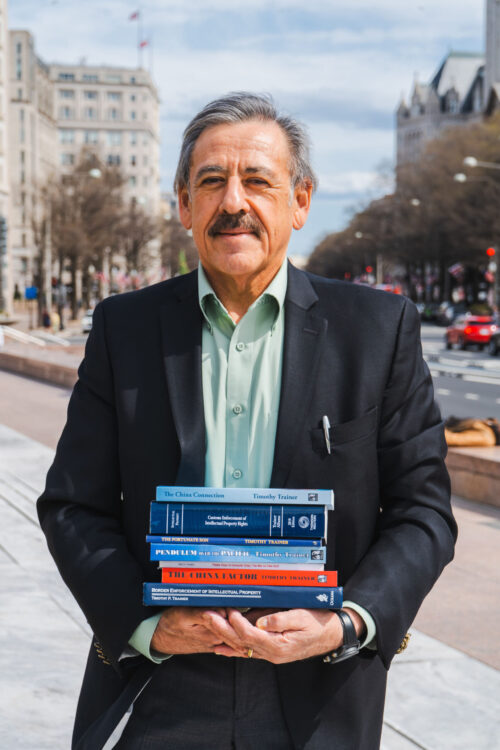 About Timothy Trainer: Writing books is a passion for attorney Timothy Trainer, who for more than three decades focused on intellectual property issues in his day job. He has worked in government agencies and in the private sector, and his assignments have taken him to 60 countries around the world.
Tim found time to pen a few non-fiction tomes, including his first book, Customs Enforcement of Intellectual Property Rights;the 15th edition was published in 2022. Thomson Reuters’ Aspatore Books published Tim’s next title in 2015, Potato Chips to Computer Chips: The War on Fake Stuff.
Fiction was a genre he always wanted to try. In 2019, Pendulum Over the Pacific was released by Joshua Tree Publishing. “This political intrigue story is set in Tokyo and Washington, D.C., and centers on trade tensions between the U.S. and Japan in the late 1980s,” Tim explains.
In 2023, the first book in his China series hit bookstores: The China Connection.
In 2025, he published the sequel, The China Factor, which ranked #63 on the Amazon Asian Literature list in May.
Coming this Fall 2026: The China Dilemma!
Click here to buy all of Tim’s books.